


/offerpages/785372a6f09c41bd8c0c1522cf87e108.jpg) Finology
Finology
 21 Sep 2026
 Table of Content
- The Origin Story of Anant Raj
- Anant Raj Business Segments
- How Anant Raj Makes Money From Data Centres
- Anant Raj Demerger: Real Estate and Data Centre Business
- Anant Raj Financial Performance
- Anant Raj Key Risks
- Anant Raj’s Corporate Governance Concerns
- Anant Raj Valuation
- Finology’s View on Anant Raj

Hello,
In our previous DeepScans, we discussed Cummins India and Blue Star, two companies that benefit from data centre growth by supplying key equipment and systems used to build these facilities.
In this edition, we look at Anant Raj Ltd., a real estate company that has been converting its existing land and buildings into data centres and is now separating its data centre and cloud businesses into a new entity.
Note: This DeepScan is an educational analysis, not a stock recommendation. Its purpose is to help you learn how we analyse businesses. If you’re looking for actionable stock recommendations, explore Finology 30
The Origin Story
Today, Anant Raj is known as a real estate developer with a fast-growing data centre and cloud business. But for much of the last two decades, the company has essentially operated as a large owner of land and buildings, trying different ways to monetise those assets. Residential projects, hotels, malls, IT parks, rental properties and now data centres have all been part of this approach.
The story goes back to 1969, when the Sarin family entered the construction business in Delhi and worked on government projects, including around 30,000 houses for the Delhi Development Authority. The listed company came later, in 1985, and started as a ceramic tile manufacturer. Over time, the promoter family’s real estate businesses were brought into the listed entity, and by around 2005, real estate had become the main business. Tile manufacturing was eventually discontinued after becoming unviable.
This was followed by aggressive land accumulation. By FY07, Anant Raj had around 928 acres of land with roughly 77 million sq. ft. of development potential, largely in and around Delhi NCR. By 2010, the land bank had increased to around 1,000 acres with close to 70 million sq. ft. of development potential.
The plan was much broader than building and selling apartments. The proposed development mix was roughly:
-
53% IT parks and SEZs
-
32% residential projects
-
14% hotels
-
2% commercial
The company doubled down after the 2008 real estate downturn. In 2010 alone, it bought around 218 acres of land for nearly ₹838 crore.
| Major land purchases in FY11 | Area | Cost |
| Sector 91, Gurugram | 15.5 acres | ₹70.0 Cr. |
| Gurugram township, residential plotted development | 106.6 acres | ₹369.6 Cr. |
| Gurugram township, commercial | 4.4 acres | ₹15.4 Cr. |
| Gurugram, residential | 43.0 acres | ₹150.5 Cr. |
| Gurugram, commercial | 6.95 acres | ₹24.3 Cr. |
| Manesar | 12.45 acres | ₹52.0 Cr. |
| Rai, Sonipat | 10.0 acres | ₹17.0 Cr. |
| Neemrana | 18.0 acres | ₹13.0 Cr. |
| Bhagwan Das Road, New Delhi | 1.5 acres | ₹126.0 Cr. |
| Total | 218.4 acres | ₹837.8 Cr. |
That is where the story started to break. Around 2010-11, brokerage estimates were extremely optimistic. One report expected rental income to rise from roughly ₹44 Cr. in FY10 to ₹121 Cr. in FY11 and more than ₹200 Cr. by FY12, supported by the Manesar IT park, hotels and the Kirti Nagar mall. Actual numbers came nowhere close.
Rental income was around ₹76 Cr. in FY11 and ₹87 Cr. in FY12. Consolidated rental and service receipts were around ₹92 Cr. in FY12, ₹90 Cr. in FY13 and had fallen to around ₹75 Cr. by FY15. Anant Raj had built the assets, but converting them into recurring cash flows proved much harder.
The IT parks make this clear. Manesar had around 1.8 million sq. ft. of constructed area, but leasing remained slow. In 2011, Motilal Oswal estimated that only around 50-55% had been leased. By FY13, the company’s annual report showed occupancy of just around 30%, even though the building was already complete.
The same thing happened at Rai. The first phase of the IT SEZ had around 2.1 million sq. ft. on 25 acres and was already completed by FY13. Management believed the project could eventually generate around ₹40 crore of annual rent once fully occupied. But that assumption depended entirely on finding enough tenants. The building was ready, but occupancy and rental income did not scale anywhere close to the original expectations.
Timing was a major reason. These IT parks were planned during the mid-2000s boom, when IT companies were expanding quickly, and office demand looked strong. By the time projects such as Manesar and Rai were completed around 2009-13, the cycle had turned after the global financial crisis. IT expansion slowed, vacancies increased, and leasing demand declined.
This history is important because Anant Raj’s current data centre strategy is largely being built on these old assets. Manesar dates back to around 2006, Rai was allotted around 2006, and Panchkula came around 2008. These properties were originally meant to generate rental income through IT parks and office infrastructure. Nearly two decades later, they are being put to a different use.
That use is data centres. By FY26, Anant Raj had 28 MW of operational capacity, including 21 MW at Manesar and 7 MW at Panchkula. The data centre, infrastructure and allied services business generated around ₹176 Cr. of revenue in FY26, while Q1 FY27 revenue alone reached around ₹90 Cr.
Management’s current capacity plan is:
-
63 MW by the end of FY27
-
117 MW by FY28
-
357 MW by FY32
So the data centre business is not a completely new chapter. It is also another attempt to extract more value from assets that Anant Raj has owned for years.
With that history in mind, let’s now look at what the business looks like today..
Breaking down Anant Raj’s Business
The company mainly operates in two segments.
| Business | What it includes | FY26 revenue | FY26 share | Q1 FY27 revenue | Q1 FY27 share |
| Real Estate | Residential projects, plots, group housing, affordable housing, commercial leasing, hotels and other rental income | ~₹2,335.1Cr. | ~93% | ~₹541.4 Cr. | ~86% |
| Data centre, Infrastructure & Allied Services | Colocation, data centre infrastructure, Ashok Cloud and related services | ~₹176.5 Cr. | ~7% | ₹90 Cr. | ~14% |
| Total Revenue from Operations | - | ₹2,511.6 Cr. | 100% | ₹631.4 Cr. | 100% |
Real Estate
Despite all the attention around data centres, Anant Raj is still primarily a real estate company today. The real estate business has two parts.
-
The first is development and sale, where the company develops residential plots, independent floors, apartments, group housing and affordable housing and sells them to customers.
-
The second is the annuity business, where Anant Raj retains commercial buildings, hotels and other properties and earns recurring rental or service income.
Anant Raj currently has around 320 acres of fully paid land across Delhi-NCR. The largest part is the 220-acre Anant Raj Estate in Sector 63A, Gurugram, on Golf Course Extension Road. The company also has around 100 acres at other locations across Delhi-NCR, of which 83.43 acres have been identified for future development. Overall, the existing land bank gives Anant Raj roughly 10-12 years of development visibility.
A large part of Anant Raj’s land in Sector 63A was acquired years ago, when Gurugram property prices were much lower than they are today. The company had acquired land or development rights for Anant Raj Estate in phases going back to 2011, 2013 and 2016, which means a meaningful part of the township was built on land bought well before the recent rise in prices on Golf Course Extension Road. By 2023, Anant Raj Estate had already grown to around 167 acres. The company has continued adding land after that and now has roughly 220 acres.
That can make a big difference to project economics. Imagine two developers selling apartments at ₹20,000-25,000 per sq. ft. Both have broadly similar construction costs, but one bought the underlying land fifteen years ago while the other bought it recently at today’s market price. The first developer starts with a much lower land cost, allowing a larger part of the selling price to potentially turn into project profit and cash.
Anant Raj currently has around 11.41 million sq. ft. of ongoing and planned residential projects. Below are the major projects:
| Project | Current status | Saleable area | Revenue/cash-flow potential |
| The Estate Residences (GH1) | Under construction | 0.99 mn sq. ft. | ~₹1,850 Cr. project value |
| The Estate Apartments | Launched in Q1 FY26 | 0.40 mn sq. ft. | ~₹750 Cr. |
| The Estate Apartments 2 | Expected to launch next | 0.40 mn sq. ft. | Not disclosed |
| The Estate One (GH2) | RERA approved in Aug 2026, ready for launch | 0.90 mn sq. ft. | ~₹2,180 Cr. |
| Group Housing 3 (GH3) | Approvals in advanced stage | 1.20 mn sq. ft. | ~₹2,886 Cr. |
| Birla Navya | Phases under delivery/construction | 764 independent floors | ~₹1,000 Cr. expected cash flow to Anant Raj |
| Aashray II, Tirupati | Under construction | 1.20 mn sq. ft. | ~₹350 Cr. |
Sector 63A is the centre of the residential business
Although Anant Raj owns land across Delhi-NCR, most of its current residential development is concentrated in Sector 63A, Gurugram. The company is developing a 220-acre township on Golf Course Extension Road, close to Golf Course Road, Sohna Road, major employment hubs and the Sector 56 metro station.
The location has worked in the company’s favour. New-launch prices on Golf Course Extension Road increased from around ₹8,800 per sq. ft. in 2019 to more than ₹20,000 per sq. ft. by 2024 and have broadly remained at these levels. In Q2 2026, multi-storey apartments on Golf Course Extension Road averaged around ₹19,000 per sq. ft., while average asking prices in Sector 63A were around ₹17,300 per sq. ft.
Higher selling prices also improve project economics because development costs remain relatively lower. Two of Anant Raj’s key projects show this:
-
The Estate Residences: Estimated project cost of around ₹1,074 Cr. against a project value of roughly ₹1,800-1,850 Cr., implying a project-level margin of around 40-42%.
-
The Estate One: Estimated project cost of around ₹1,335 Cr. against expected revenue of ₹2,180 Cr., implying a margin of close to 39%.
Outside NCR, the main residential project is Aashray II in Tirupati, Andhra Pradesh. It is an affordable housing project spread across 10.14 acres, with 1,848 units, 1.2 million sq. ft. of saleable area and projected revenue of around ₹350 crore.
Moving from plots to higher value apartments
Anant Raj has historically monetised its Sector 63A land through a mix of plots, independent floors and apartments. Ashok Estate, for example, was mainly a plotted project, where the company divided the land into smaller plots and sold them to buyers, who could then build their own homes. Birla Navya, on the other hand, focused on luxury independent floors. These formats are relatively quicker to build and sell, so cash comes back faster.
The company is now moving more towards premium and luxury apartments because demand in Gurugram has shifted towards higher-priced homes, particularly in the ₹3-10 crore segment. Apartments also allow Anant Raj to earn much more from the same piece of land. Instead of selling one plot once, it can build several floors vertically and sell many apartments on that land.
This shift is already visible in pricing. The Estate Residences is selling at around ₹18,000 per sq. ft., while The Estate Apartments carries estimated revenue of ₹750 crore on 0.40 million sq. ft., implying roughly ₹18,750 per sq. ft.
Birla Navya JV and asset-light monetisation
Birla Navya is another way Anant Raj can monetise its land without taking on the full responsibility of developing the project itself.
The project is spread across 47 acres in Sector 63A and includes 764 luxury independent floors across 191 plots. Anant Raj contributes the land, while Birla Estates handles development and marketing.
The project is already well advanced. Phase I has been delivered, Phase II deliveries have started, Phase III is under development and Phase IV has also been launched. Across all four phases, Anant Raj expects around ₹1,000 Cr. of cash flow, including money already received and the amount still expected.
Annuity/commercial rental business
Apart from selling residential projects, Anant Raj also owns commercial and hospitality properties that generate recurring rental income.
In these properties, the company mainly acts as the asset owner rather than operating the hotels itself. The two main properties are Anant Raj Centre 1 in South Delhi and Anant Raj Centre 2 on NH-8.
Centre 1 currently has around 70,000 sq. ft. of operational area. Another 4.90 lakh sq. ft. is under construction, which will include commercial space, serviced apartments, a motel and banquet facilities. The company expects this additional space to generate around ₹55 Cr. of annual rental income.
Centre 2 has around 90,000 sq. ft. of existing space. Anant Raj plans to add another 6.10 lakh sq. ft., consisting of commercial units, serviced apartments, a motel and banquet facilities. The company estimates that this expansion can add around ₹75 Cr. of annual rental income.
Overall, the real estate business continues to have a strong launch and rental pipeline.
-
Estate One, spread across 5.09 acres with around 0.9 million sq. ft. of saleable area, was launched in August 2026 with an estimated project value of around ₹2,180 crore and targeted selling prices of ₹23,000-24,000 per sq. ft.
-
Another luxury project, Group Housing 3, is planned over 6.38 acres with around 1.20 million sq. ft. of saleable area and estimated revenue potential of around ₹2,886 Cr.
On the annuity side, Anant Raj sees potential for around ₹210 Cr of additional annual rental income from the expansion of Anant Raj Centre 1, Centre 2 and Ashok Tower. The full benefit will take time to come through, with Ashok Tower targeted for completion by FY29 and some of the larger hospitality expansions likely extending towards FY30.
Data Centre, Infrastructure & Allied Services
Anant Raj entered the data centre business in 2019, initially through colocation services. In this, customers bring their own servers, while Anant Raj provides the secure building, racks, electricity, cooling, backup power and network connectivity needed to keep those servers running.
The company already owned large technology parks at Manesar, Panchkula and Rai, which had been developed as part of its earlier real estate operations. Instead of continuing to use these properties only as conventional IT parks, Anant Raj started converting them into data centres.
This gave the company an important advantage. A new data centre normally requires land, construction of the building, power infrastructure, cooling systems, networking equipment and several approvals. Anant Raj already owned the land and buildings at its main locations. Its job was therefore largely to install the specialised infrastructure required to run a data centre.
Management has said that Anant Raj can develop brownfield data centre capacity at around ₹25-26 Cr. per MW because the land and much of the building infrastructure are already in place, compared with roughly ₹50-60 Cr. per MW for a new entrant starting without land or existing buildings. For Anant Raj’s greenfield capacity, the cost is higher at around ₹34 Cr. per MW.
The opportunity itself is large. India’s data centre capacity increased from around 375 MW in 2020 to roughly 1,500 MW by 2025, and had reached around 1.8 GW by H1 2026. Third-party operational capacity to increase further to around 2.4-2.5 GW by FY28, requiring roughly ₹90,000 crore of investment between FY26 and FY28.
How does the business make money?
The business currently has two main parts: colocation and cloud services.
Colocation is the simpler model. A customer such as a bank, technology company or large enterprise owns its servers but does not want to construct and operate its own data centre. It places those servers inside Anant Raj’s facility.
Anant Raj provides the racks, uninterrupted power, backup systems, cooling, network connectivity, security and the physical infrastructure needed to keep those servers running. The customer continues to own and control the servers and software.
The economics of colocation are relatively simple:
-
Revenue: around ₹90 lakh per month per MW
-
EBITDA margin: around 75%
-
Brownfield capex: roughly ₹27 Cr. per MW in FY26
Cloud goes a step further. Instead of customers bringing their own servers, Anant Raj provides computing power, storage and networking through Ashok Cloud.
The company launched Ashok Cloud in October 2024, initially through Infrastructure as a Service, or IaaS, where customers rent computing power, storage and servers from Anant Raj instead of owning the hardware themselves. It has since started adding platform and managed services. Management has indicated cloud revenue of around ₹12 Cr. per month per MW, far higher than colocation.
But the cloud also requires much more capital. In colocation, the customer owns the expensive servers. In cloud, Anant Raj has to invest in servers, storage, networking equipment and, over time, GPUs and other computing hardware.
Cloud capex is around ₹100 Cr. per MW, compared with roughly ₹26 Cr. per MW for brownfield colocation capacity. So while cloud can generate much higher revenue from each MW, it also requires substantially more capital. Hardware also becomes obsolete much faster than a building, which means depreciation and replacement capex become more important.
Anant Raj does not want to remain only a company that rents data centre space. It is gradually trying to provide more services to customers, such as computing power, data storage, backup, system monitoring, software support and other technology services needed to run their operations.
The idea is simple: instead of earning only from space, power and cooling, the company wants to earn from more services built on top of the same data centre infrastructure. This can increase revenue from each MW of capacity.
As of Q1 FY27, Anant Raj had 28 MW of operational data centre capacity:
-
Manesar: 21 MW
-
Panchkula: 7 MW
Management expects capacity to rise to 63 MW by the end of FY27, 117 MW by FY28 and 357 MW by FY32. At the FY32 target, capacity would be spread across:
-
Manesar: 50 MW
-
Panchkula: 57 MW
-
Rai: 200 MW
-
Andhra Pradesh: 50 MW
This implies a capacity CAGR of roughly 53% between FY26 and FY32.
The next major step is the 63 MW capacity. Management has said that once this capacity is fully occupied and handed over to customers, it should be capable of generating around ₹1,200 crore of annual revenue, with a substantial contribution expected in FY27 and the full run-rate expected in FY28.
If the ₹1,200 crore run-rate is achieved by FY28, revenue would increase from ₹176.5 crore in FY26 to around ₹1,200 crore, implying a very high ~161% CAGR over two years.
The customer base is also fairly diversified between the public and private sectors. As of H1 FY26, management said around 75% of colocation customers were from the government side and 25% from the private sector, while cloud customers were roughly 50:50 between government and private clients.
Government business could become an important source of demand. Anant Raj Cloud has been empanelled with MeitY as a sovereign government cloud provider and with BSNL as a data centre service provider. In simple terms, these approvals allow the company to compete for government, telecom and public-sector workloads that require data to be hosted on approved and secure infrastructure.
Now coming to planned demerger
Anant Raj now plans to separate its real estate and data centre businesses. The data centre and cloud business will be moved into Ashok Cloud, which is expected to be listed separately. Existing Anant Raj shareholders will receive one share of Ashok Cloud for every one share of Anant Raj they own.
The reason is simple. Real estate and data centres are very different businesses. Real estate needs land and construction capital and generates cash through project sales and collections. Data centres require regular investment in power systems, cooling, servers and other technology, but can generate recurring revenue once capacity is occupied. Keeping them separate allows each business to have its own management, capital allocation and growth strategy.
A separate listing could also make valuation easier. Today, investors have to value a real estate business and a fast-growing digital infrastructure business together. Once Ashok Cloud is listed separately, the market can value its data centre capacity, cloud business and expansion plans on their own.
It could also make fundraising easier. Ashok Cloud would be able to raise capital or bring in strategic investors specifically for its data centre expansion, without mixing that capital with Anant Raj’s real estate projects.
After the demerger, Ashok Cloud would become a more focused data centre and cloud company, while Anant Raj would continue to have exposure to the business through its stake in the new company.
On a consolidated basis…
Anant Raj’s financial performance has changed sharply since the FY21 demerger. Revenue increased from around ₹250 crore in FY21 to ₹2,512 crore in FY26, a CAGR of roughly 59%, while PAT increased from just ₹11 crore to ₹557 crore, implying a CAGR of around 120% over the same period.
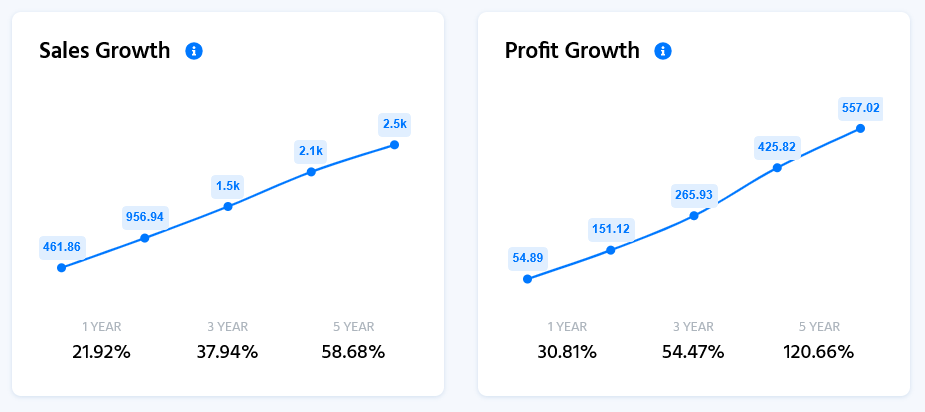
(Source - Finology Ticker)
At the same time, the company reduced net debt from nearly ₹1,500 crore to a net-cash position, although equity raises have also contributed to the improvement, including a ₹500 crore QIP in FY24 and another ₹1,100 crore in FY26.
This also leads to dilution for existing shareholders. The business is not generating enough internal cash to fund its growth entirely on its own, so the company has to raise equity from time to time. Each new share issuance reduces the ownership of existing shareholders.
If Anant Raj has to keep raising equity every few years, part of the reported growth will effectively be funded by issuing more shares. In that case, the headline growth numbers become less attractive because the benefit is being spread across a larger number of shares.
Now coming to key risks
-
Heavy dependence on Gurugram and NCR
A large part of Anant Raj’s current and upcoming residential pipeline is concentrated in Sector 63A, Gurugram and the wider NCR market. This has worked well because premium housing demand in Gurugram has been strong, but it also creates concentration risk. If property demand weakens, launches slow down, or buyers become less willing to pay premium prices, Anant Raj’s sales, collections and margins could be affected.
The concentration risk is not theoretical. NCR has gone through a prolonged property downturn before. Residential launches fell from around 149,000 units in FY11 to just 13,000 in FY21, while annual absorption dropped from 116,000 units to around 20,000, declines of roughly 91% and 83%, respectively.
-
Increasing exposure to premium housing
The company is moving from plots and independent floors towards larger premium apartment projects. This can generate much more revenue from the same land, but it also increases dependence on a smaller pool of affluent buyers and puts Anant Raj directly against some of the largest developers in Gurugram. Around Golf Course Extension Road alone, upcoming projects include DLF, M3M, Godrej Properties, Emaar, Max Estates, Conscient and Smartworld, with Godrej and Conscient also launching in Sector 63A, the same micro-market as Anant Raj Estate. Nearly ₹1 lakh crore of luxury housing launches are reportedly lined up across Gurugram in H2 FY27, which could significantly increase competition.
There are also early signs that demand is no longer running at the pace seen over the last few years. Colliers noted that Gurugram luxury housing has shown moderation over the last 2-3 quarters, with developers increasingly offering easier, back-ended payment plans to sustain demand. At the broader NCR level, residential sales declined 9% YoY in Q2 2026, while Gurugram still remained the largest market with 43% of NCR sales.
-
Data centre business is still not proven
Anant Raj’s data centre plan involves a very large scale-up, from 28 MW operational today to 63 MW by FY27, 117 MW targeted to commence by FY28 and 357 MW by FY32. This means planned capacity is nearly 13 times the current level, so execution and utilisation have to rise together.
The risk is visible even at the current scale. In H1 FY26, while 28 MW was operational, only 8 MW of colocation and 0.5 MW of cloud capacity had been fully handed over to customers, with the rest still under handover.
If capacity is built faster than customers are added, a large amount of capital could remain tied up in underutilised assets, lowering returns.
-
Competition in data centres is intense
Competition in data centres is intense. Anant Raj is still a relatively small player in a market dominated by much larger operators. Based on recent industry estimates, NTT accounts for around 20% of India’s operational capacity, followed by Sify and STT at around 19% each, while Nxtra and CtrlS hold roughly 15% each. In comparison, Anant Raj’s current 28 MW represents only around 1.5-1.6% of India’s roughly 1.8 GW operational capacity. The company therefore has to compete against players with much larger capacity, longer operating histories and established relationships with large cloud and enterprise customers. Competition is likely to increase further as existing operators and new entrants continue adding capacity.
Corporate Governance Issues…
The company’s history of aggressive capital allocation, complicated group structures and large inter-company funding is worth paying attention to.
The clearest current concern is the Enforcement Directorate search in April 2026. ED officials searched Anant Raj’s office and premises linked to certain officers while seeking information related to the past sale of an investment in one of its former associate companies.
The Roseland Buildtech investment itself raises questions. Anant Raj invested roughly ₹148 Cr. in the company and eventually sold its entire 50% stake in FY24 for around ₹88 Cr. Despite holding the investment for close to two decades, the exit value was below the original investment cost. The transaction also had a complicated history, while the company’s disclosures provided limited detail around the eventual exit.
Capital allocation has been a weak spot historically. During the previous real-estate cycle, Anant Raj aggressively purchased land and allowed debt to rise above ₹1,000 Cr. Management repeatedly talked about reducing leverage, but debt remained elevated for years. This history matters because the company is once again entering a large investment cycle, this time in data centres, with long-term capex ambitions running into thousands of crores. Management has previously overextended the balance sheet during an expansion phase. This time, part of the funding is being raised through equity.
Related-party exposure is another area we do not like. Around ₹817 Cr. of loans were outstanding to related parties in FY26, representing roughly 95% of the company’s total standalone loan book. Most of these appear to be loans to subsidiaries, JVs and operating entities rather than money given directly to promoters. Having such a large amount of money moving across a group with more than 40 subsidiaries makes the structure unnecessarily difficult to track for retail investors.
In Finology 30, this is exactly the kind of distinction we try to make. We look not only at how fast a company can grow, but also at how responsibly it funds that growth, how management has allocated capital in the past, and whether the governance structure gives us confidence the business can compound sustainably over the long term.
Coming to valuations…
Anant Raj currently trades at around 37x earnings, which is about 12% above its historical median P/E of around 33x.
| Exit P/E after five years | PAT CAGR required for 15% return |
| 25x | 24.40% |
| 33x | 17.70% |
| 40x | 13.20% |
If the stock returns to its historical median valuation of 33x after five years, PAT would need to grow at around 17.7% CAGR for investors to earn a 15% annual return, excluding dividends.
At the same 33x exit multiple, 20% PAT growth would give around 17.3% annual returns, while 25% PAT growth would give around 22.2%.
The required growth does not look very demanding. FY26 PAT was ₹557 crore, so 17.7% growth would take PAT to around ₹1,260 crore by FY31. Given the existing residential pipeline and the planned increase in data centre capacity from 28 MW to 63 MW by FY27, this earnings growth appears achievable if execution remains on track.
The bigger risk is dilution. If future data centre expansion requires another large equity raise, PAT can grow strongly while EPS grows more slowly. For shareholders, ultimately it is EPS growth, not just PAT growth, that matters.
In our view..
At Finology, we prefer companies that can fund growth largely through the cash generated by the business itself. Anant Raj does not meet that standard. Over the last five years, the company has raised around ₹1,900 Cr. through equity and related instruments to fund expansion and reduce debt.
Repeated equity raising dilutes existing shareholders and reduces the benefit of growth on a per-share basis. Along with the governance concerns discussed above, this means Anant Raj does not qualify under our investment checklist.
Disclaimer
Investment in securities market are subject to market risks. Read all the related documents carefully before investing. The information and analysis provided herein are for educational and informational purposes only and do not constitute investment advice, a research recommendation, or an offer, solicitation, or recommendation to buy, sell, or hold any security. Investors should exercise their own judgment, conduct independent due diligence, and consult professional advisers before making investment decisions. Finology Ventures Private Limited, its affiliates, directors, employees, and research analysts shall not be liable for any loss or damage arising from the use of or reliance on this information.