


 Finology
 12 Oct 2026
 Table of Content
- India's Motorcycle Market: Shift Towards Higher-Capacity Motorcycles
- Bajaj Auto Business Model and Revenue Segments
- Bajaj Auto Financial Performance
- Bajaj Auto vs Hero MotoCorp vs TVS Motor: Peer Comparison
- Bajaj Auto Future Growth Opportunities
- Key Risks in Bajaj Auto Stock
- Bajaj Auto Stock Valuation: P/E Ratio and Return Potential
- Bajaj Auto Stock Analysis: Final Outlook

Hello,
In this edition, we look at Bajaj Auto Ltd., India’s largest two-wheeler exporter and the world’s largest three-wheeler manufacturer. In FY26, it held around 10.5% of India’s domestic two-wheeler market, 73.8% of conventional three-wheelers, 20.7% of electric scooters and 33.5% of L5 electric autos. Bajaj is also well positioned to benefit as more Indians shift toward higher-capacity motorcycles, with bikes of 125cc and above accounting for nearly 77.5% of its domestic motorcycle sales.
Note: This DeepScan is an educational analysis, not a stock recommendation. Its purpose is to help you learn how we analyse businesses. If you’re looking for actionable stock recommendations, explore Finology 30.
India's Motorcycle Market: Shift Towards Higher-Capacity Motorcycles
For decades, buying a motorcycle in India was mainly about affordability, mileage and low maintenance costs. Most first-time buyers wanted something reliable, economical and easy to maintain. A 100cc motorcycle was enough for daily commuting while keeping fuel expenses low. This made models such as the Hero Splendor, HF Deluxe and Bajaj Platina some of the most popular motorcycles in the country.
However, India’s motorcycle market has changed considerably over the last seven years.
FY19 was a record year for the industry, with domestic motorcycle sales reaching nearly 1.36 crore units. Entry-level motorcycles with engines up to 110cc accounted for around 62% of the market, with approximately 84 lakh units sold. The remaining 52 lakh units came from larger-engine motorcycles.
Seven years later, in FY26, domestic motorcycle sales stood at around 1.31 crore units, still below the FY19 peak. However, the type of motorcycles Indians were buying had changed considerably.
The decline was concentrated in entry-level motorcycles. Sales fell from around 84 lakh units in FY19 to 59 lakh units in FY26, down nearly 30%.
Meanwhile, sales of motorcycles with engines of 110cc and above rose from about 52 lakh to 72 lakh units, up around 38%. Their share of the domestic motorcycle market increased from 38% to nearly 55%.
This shift was driven by two major factors: rising entry-level motorcycle prices and changing customer preferences.
Rising prices made entry-level motorcycles less affordable
The motorcycle industry had enjoyed several years of growth leading up to FY19, supported by rural demand and easier access to financing. However, demand started weakening in the second half of FY19 as rural incomes came under pressure and the NBFC liquidity crisis affected financing availability.
Around the same time, buying a motorcycle started becoming more expensive.
In September 2018, the government made five years of third-party insurance mandatory for new two-wheelers. This increased the amount buyers had to pay upfront.
Then, in April 2019, stricter braking safety regulations became mandatory for existing motorcycle models. Motorcycles up to 125cc were required to have a Combined Braking System (CBS), which helps apply braking force to both wheels even when the rider uses only one brake. This improves braking balance and reduces the chances of skidding, particularly for inexperienced riders.
Motorcycles above 125cc were required to have an Anti-lock Braking System (ABS), which prevents the wheels from locking during sudden or hard braking. For example, if a rider brakes suddenly on a wet road, the wheels can lock, and the motorcycle may skid. ABS automatically adjusts brake pressure to help keep the wheels rotating, allowing the rider to maintain better control.
These changes improved safety but also increased manufacturing costs. CBS increased motorcycle prices by around ₹500–1,000, while ABS added approximately ₹4,000–9,000 to higher-capacity motorcycles. For example, when Bajaj introduced ABS on the Pulsar 220F in 2019, its ex-showroom price increased by around ₹7,600.
The next major increase came in April 2020, when India introduced BS6 emission standards.
BS6 introduced stricter limits on harmful gases released by vehicle engines. To meet these standards, manufacturers had to upgrade their engines and exhaust systems.
Many motorcycles moved from carburettors, which mechanically mix fuel and air, to electronic fuel injection, which uses sensors to deliver a more precise fuel amount. Manufacturers also added improved catalytic converters, which reduce harmful exhaust emissions.
These changes made motorcycles cleaner and more efficient, but also increased their manufacturing costs.
For example, when Hero introduced the BS6 version of the HF Deluxe in early 2020, its price increased from ₹48,575 to ₹55,925. That was an increase of ₹7,350, or around 15%, during the transition.
And prices continued to rise.
During FY21 and FY22, manufacturers faced higher costs for steel, aluminium and other raw materials. A portion of these additional costs was passed on to customers through higher motorcycle prices.
According to CRISIL, the combined impact of emission regulations, safety requirements and rising commodity prices increased economy motorcycle prices by approximately 65–70% between FY19 and FY25.
This affected entry-level buyers the most. Many of these motorcycles are purchased by agricultural workers, small traders and lower-income households who need an affordable means of transport.
For these customers, even an additional ₹10,000–15,000 can make a meaningful difference to their purchasing decision. As prices rose, many buyers postponed purchases or kept using their existing motorcycles longer.
Changing preferences supported higher-capacity motorcycles
Interestingly, higher-capacity motorcycles also became more expensive during this period. Yet, their demand remained relatively strong.
One reason was differences in customer’s purchasing power and preferences.
Entry-level buyers generally focus on affordability, mileage and maintenance costs. Customers buying higher-capacity motorcycles are often willing to spend more on better performance, design, comfort and additional features.
These buyers also tend to have higher disposable incomes, putting them in a better position to absorb price increases.
The 125cc category benefited from another advantage.
Under the braking regulations introduced in 2019, motorcycles up to 125cc could use the relatively less expensive CBS system, while motorcycles above 125cc generally required ABS.
This let manufacturers offer 125cc motorcycles with better performance and styling than basic 100cc bikes, without the added cost of mandatory ABS.
As a result, the 125cc category became an attractive option for customers looking to upgrade from entry-level motorcycles without spending significantly more on a 150cc bike.
Manufacturers also introduced more models and features to attract these customers. The number of premium motorcycle models available in India increased from 23 in FY19 to 35 in FY25. Customers had more choices across different engine capacities, designs and price points.
As a result, demand gradually shifted toward larger, more expensive motorcycles, even as the overall motorcycle industry struggled to return to its earlier peak.
More recently, the GST reduction in September 2025 brought some relief to motorcycle buyers. The tax rate on motorcycles up to 350cc was reduced from 28% to 18%, lowering prices across both entry-level and higher-capacity models.
This could support a recovery in overall motorcycle demand, particularly among price-sensitive buyers.
This brings us to Bajaj Auto.
The company has increasingly focused on higher-capacity and premium motorcycles through brands such as Pulsar, Dominar, KTM and Triumph. In FY26, nearly 78% of its domestic motorcycle sales came from the 125cc-and-above category.
Breaking down Bajaj Auto’s Business
Bajaj Auto has three business segments.
| Business segment | Segment Revenue | Revenue share | Segment profit | Profit share | Segment margin |
| Automotive | 60,530 Cr. | 93.00% | 12,016 Cr. | 84.50% |
19.90% |
| Financing | 3,248 Cr. | 5.00% | 889 Cr. |
6.30% |
27.40% |
| Investments | 1,309 Cr. | 2.00% | 1,307 Cr. |
9.20% |
99.80% |
| Total | 65,087 Cr. | 100% | 14,212 Cr. |
100% |
- |
1. Automotive
This is the company’s core business. This segment accounts for almost 93% of the company’s business. This involves manufacturing and selling motorcycles, electric scooters, three-wheelers and spare parts in India and overseas.
The business has five major categories:
-
Domestic motorcycles: Commuter motorcycles under CT and Platina, sports motorcycles under Pulsar and Dominar, CNG motorcycles under Freedom, and premium motorcycles manufactured in partnership with KTM and Triumph.
-
Electric two-wheelers: Electric scooters sold under the Chetak brand, along with electric mobility products associated with Yulu.
-
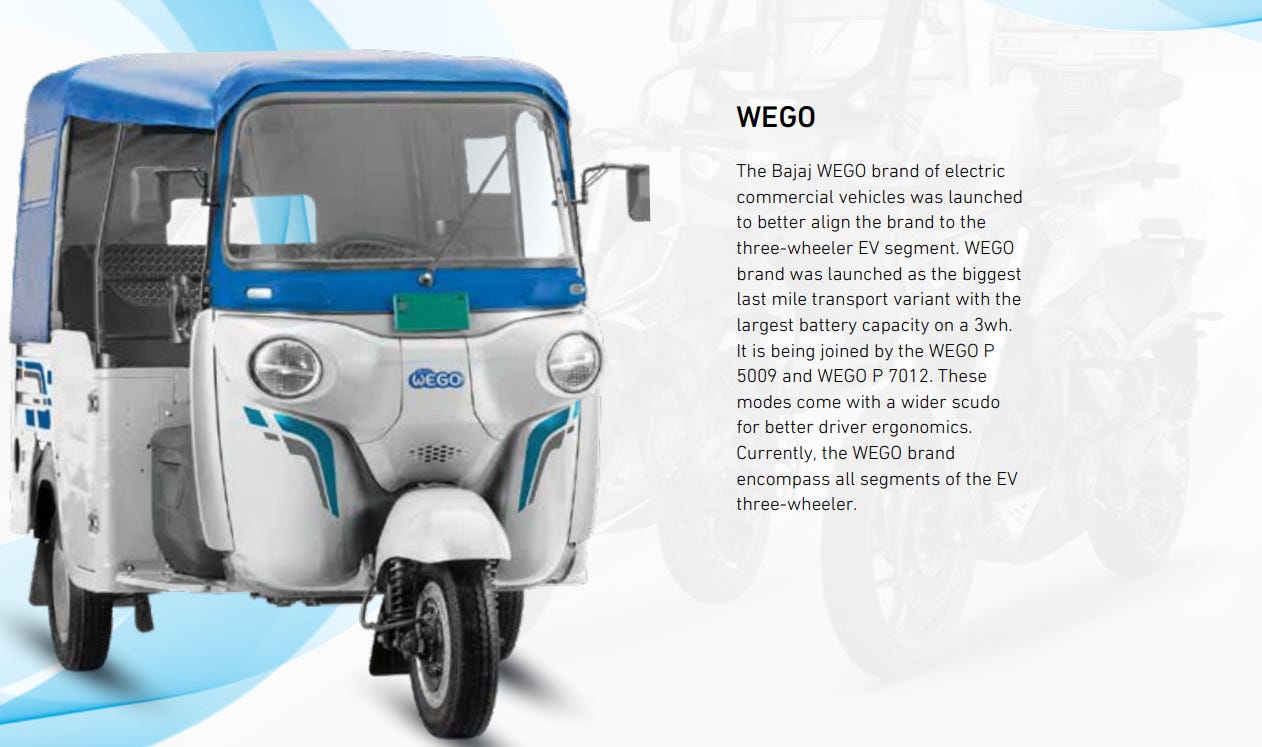
Commercial vehicles: Passenger and cargo three-wheelers sold under the RE and Maxima brands, electric three-wheelers under WEGO, and electric rickshaws and cargo vehicles under Riki.
-
Exports: Motorcycles and three-wheelers sold in international markets, including Bajaj-branded products and motorcycles manufactured for KTM and Triumph.
-
Spare parts: Replacement parts and components sold through domestic and international distribution networks.
Over the last 5 years, automotive revenue grew at a CAGR of ~16%, while volumes grew at ~5% CAGR. That shows the revenue is mainly driven by price increases rather than selling more vehicles. One key reason was the shift toward higher-priced motorcycles. The share of 125cc+ motorcycles in domestic motorcycle sales increased from around 63% in FY23 to 77.5% in FY26. In addition, price increases, higher contributions from electric vehicles and commercial vehicles, and favourable currency movements in exports also supported revenue growth.
This shift is also reflected in the EBITDA margin. Standalone EBITDA margins increased from 17.8% in FY21 to 20.5% in FY26.
| Business | FY26 scale | Market position | Our assessment |
| Domestic motorcycles | 20.4 lakh units | 15.6% share, down from 18.2% in FY24 | Weakest competitive performance; needs market share recovery |
| Exports | 22.5 lakh units; ₹20,416 Cr. revenue | No. 1 in 9 of 15 key motorcycle export markets | Major growth driver, with currency and emerging-market risks |
| Three-wheelers | 4.25 lakh ICE + 90,342 L5 EV units domestically | 73.8% ICE share; 33.5% L5 EV share | Strongest franchise, but overall share faces pressure from EV transition |
| Chetak | 3.03 lakh units; over ₹4,000 Cr. revenue | 20.7% electric scooter share | Established EV business with improving profitability |
| KTM and Triumph | Over 1.3 lakh units domestically; ~₹5,000 Cr. global revenue | Growing premium motorcycle franchise | Overseas KTM turnaround remains a risk |
Domestic Motorcycles: Increasing Focus on Premiumisation
Bajaj Auto has gradually shifted its domestic motorcycle portfolio towards the 125cc+ segment, where motorcycles generally command higher selling prices and offer better profitability than entry-level commuter bikes. By FY26, motorcycles above 125cc accounted for 77.5% of Bajaj Auto’s domestic motorcycle volumes.
Pulsar remains central to this strategy and is the company’s largest motorcycle brand. In FY26, the brand generated more than ₹16,500 Cr. in global revenue, contributing around 27% of automotive segment revenue and 26% of consolidated revenue.
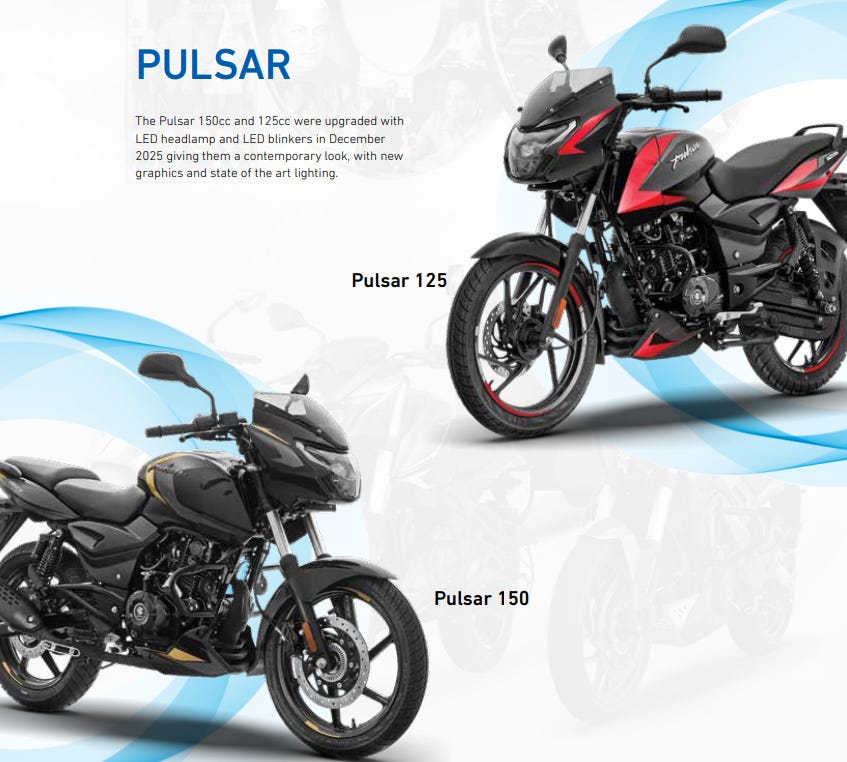
However, Bajaj’s increasing focus on higher-capacity motorcycles has not translated into higher market share. Its share of the domestic motorcycle market declined from 18.2% in FY24 to 15.6% in FY26, largely because competition increased in some of its most important categories.
This has been particularly visible in the 125cc and 150-250cc segments, where Pulsar has historically held a strong position. Bajaj’s market share in the 125cc segment declined from 27.1% in FY24 to 21.9% in FY26, while its share in the 150-250cc segment fell from 34.6% to 31.4% over the same period.
Competitors such as Honda, Hero and TVS gained market share through products including the Honda Shine, Hero Xtreme 125R and TVS Raider. Bajaj also faced pressure because parts of its Pulsar portfolio had become outdated compared with newer competing models.
In addition, Bajaj has deliberately avoided aggressive discounting in the low-margin 100cc category, which has also contributed to its overall market share decline.
To address these issues, the company has introduced several new and upgraded Pulsar models. Early improvements are visible in the 150cc+ category, where Bajaj reported growth of around 1.5 times the industry rate in Q1 FY27.
Exports: Geographic Diversification
Bajaj Auto is India’s largest two-wheeler exporter, accounting for approximately 41% of India’s total two-wheeler exports during April-August FY27, followed by TVS Motor at 28%. The company exports motorcycles under the Bajaj, KTM and Triumph brands, along with passenger and cargo three-wheelers. It operates in more than 100 countries, with Africa, Latin America and Asia being its major markets.
Bajaj’s export business is largely driven by smaller, affordable motorcycles, unlike its domestic business, where the company has increasingly focused on premium motorcycles. Models such as Boxer and CT are particularly popular in African markets, where motorcycles are widely used for daily commuting and commercial transportation. During the first five months of FY27, motorcycles in the 100-125cc category accounted for approximately 71% of Bajaj’s motorcycle export volumes.
Customers in these markets are generally price-sensitive, as they often buy motorcycles for daily transportation or to earn a livelihood. Vehicle prices, fuel efficiency, maintenance costs and the availability of spare parts are therefore important factors in purchase decisions. Bajaj’s established brands and wide distribution network have helped it maintain a strong position in these markets.
In Latin America, however, demand for higher-capacity motorcycles such as Pulsar and Dominar has been increasing. These motorcycles generally command higher selling prices, allowing Bajaj to improve its product mix and earn more revenue per vehicle.
Exports have historically been an important part of Bajaj’s business, although the segment experienced considerable volatility during FY22-26. Volumes peaked at 25.1 lakh units in FY22 before declining to 16.4 lakh units in FY24, largely due to foreign exchange shortages, currency depreciation and weak economic conditions in African markets, particularly Nigeria.
The recovery began in FY25 and gained pace in FY26, when export volumes grew 20.8% to 22.5 lakh units. Export revenue also reached a record ₹20,416 Cr., growing 25.6% YoY.
Despite export volumes remaining around 10% below FY22 levels, revenue was approximately 21% higher in FY26. This was supported by better realisations from a higher share of premium motorcycles and commercial vehicles, price increases and rupee depreciation.
Bajaj also outperformed its underlying export markets in FY26. Motorcycle exports increased 17%, compared with around 10% growth in the industry, while commercial vehicle exports grew 49.2%, compared with industry growth of 44%. The company maintained leadership in nine of its 15 key motorcycle export markets and 11 of its 12 key commercial vehicle export markets
The geographical mix of exports has also been changing, with markets outside Nigeria contributing more to growth. Latin America recorded its highest-ever sales in FY26, while motorcycle export volumes in East Africa and South Asia grew 54% and 36%, respectively.
Bajaj has also expanded its manufacturing operations in Brazil, where annual production capacity reached 50,000 units. Sales in the country more than doubled to approximately 32,000 units in CY25, making Brazil an increasingly important market for the company.
However, Bajaj’s export business remains dependent on developing markets, where currency depreciation, foreign exchange shortages, and high inflation can affect demand and distributors’ ability to import vehicles. This was visible during FY23-24, when distributors in markets such as Nigeria struggled to obtain foreign currency to pay for imported motorcycles, leading to a sharp decline in export volumes.
Commercial Vehicles
Bajaj Auto is the world’s largest three-wheeler manufacturer. In FY26, the company held 73.8% of the domestic conventional (ICE) three-wheeler market, including 79.1% in passenger carriers and 52.5% in goods carriers. It also became the market leader in L5 electric three-wheelers, with a 33.5% share.
Over FY21-26, Bajaj’s total commercial vehicle volumes rose from about 3.7 lakh units to 8.0 lakh units, a CAGR of around 17%. The business benefited from the post-pandemic recovery in passenger transportation, growing demand for last-mile mobility, and the expansion of electric three-wheelers.
Passenger carriers accounted for approximately 86% of Bajaj’s domestic ICE three-wheeler volumes in FY26. The company also held an 87.9% share in the CNG category.
Its L5 electric three-wheeler volumes increased from just 12,231 units in FY24 to 90,342 units in FY26, while market share rose from 12% to 33.5%. Passenger vehicles accounted for approximately 94% of its electric volumes, while its market share in electric goods carriers remained relatively low at 16.9%.
Electric three-wheelers offer substantial savings in running costs compared with CNG vehicles. At a CNG price of ₹87/kg and mileage of around 28 km/kg, fuel costs about ₹3.10/km. In comparison, an electric three-wheeler consuming one unit of electricity per 10 km, at ₹8/unit, costs around ₹0.80/km. This translates into savings of approximately ₹6,000-9,000 per month for drivers covering 100-150 km daily over 26 working days, or roughly ₹72,000-1.08 lakh annually. Lower maintenance costs can further improve the economics, although higher purchase prices, financing costs and eventual battery replacement expenses reduce the overall benefit.
As the industry shifts toward EVs, Bajaj needs to gain market share in electric vehicles to offset the gradual decline in its conventional business. Competition is also increasing, particularly from Mahindra and TVS, which have expanded their electric passenger and cargo portfolios.
Bajaj has also expanded its electric portfolio under the WEGO brand, offering passenger and cargo variants, and entered the electric rickshaw market through Riki. Its established dealer network, financing relationships and service infrastructure provide an advantage as customers move from conventional vehicles to electric alternatives.
Electric Scooters
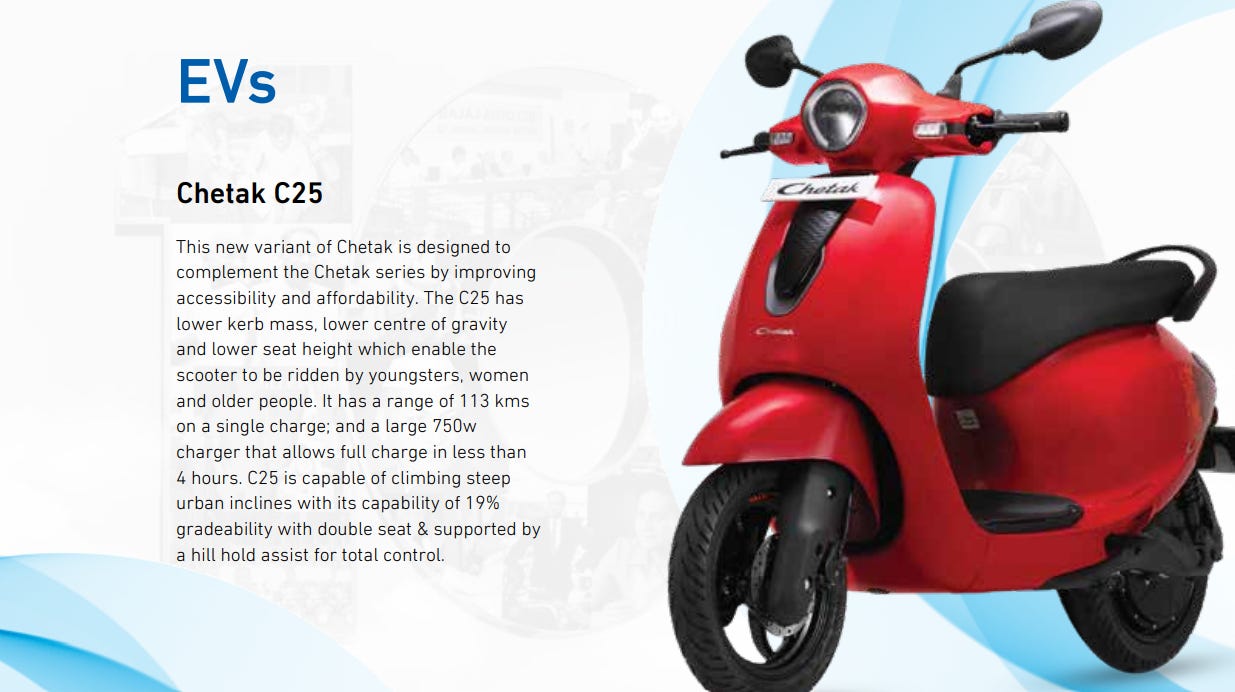
Bajaj Auto re-entered the scooter market in 2020 through Chetak, choosing to focus entirely on electric scooters rather than competing with established petrol scooter manufacturers such as Honda and TVS
Annual sales increased from approximately 1.16 lakh units in FY24 to 3.03 lakh units in FY26. Revenue crossed ₹4,000 Cr. in FY26, while Chetak’s market share reached 20.7%, making it one of India’s two largest electric scooter brands.
The company has also built a dedicated distribution network rather than relying entirely on existing motorcycle dealerships. By Q1 FY27, Chetak had over 530 exclusive stores and approximately 4,500 customer touchpoints across more than 850 cities. Management plans to expand the exclusive network towards 1,000 stores over the next few years.
In FY26, Chetak reached EBITDA breakeven after several years of losses. By Q1 FY27, management confirmed that the business had become EBITDA-positive.
We see Chetak as an important long-term growth opportunity, particularly as electric scooters gain acceptance among everyday commuters. Bajaj’s manufacturing experience, brand reputation and expanding service network provide competitive advantages.
Premium Motorcycles (KTM and Triumph)
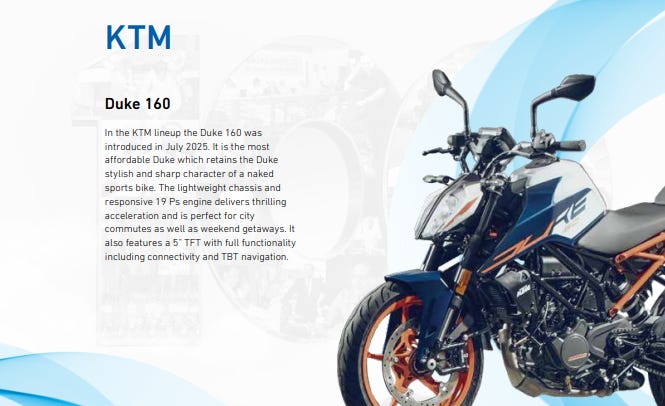
Bajaj has expanded its presence in premium motorcycles through partnerships with KTM and Triumph. While KTM focuses on performance-oriented sports and adventure bikes, Triumph mainly targets customers looking for modern-classic motorcycles. These partnerships allow Bajaj to compete in higher-priced segments of the motorcycle market.
In FY26, KTM and Triumph together generated approximately ₹5,000 Cr. in global revenue, growing around 40% YoY. Domestic sales crossed 1.3 lakh units, while global sales reached around 2.25 lakh units.
Bajaj manufactures smaller-capacity motorcycles for both brands at its Chakan facility in India, catering to domestic and export markets. Local manufacturing helps keep prices competitive by using Bajaj’s existing production facilities and supplier network.
To reach more customers, Bajaj is also expanding its dealership network through dedicated premium outlets and combined KTM-Triumph showrooms. By Q1 FY27, nearly 90 combined outlets were operational, allowing both brands to enter smaller markets where running separate dealerships may not be financially viable.
The revised GST structure also creates an opportunity for these brands. Motorcycles up to 350cc attract 18% GST, compared with 40% for those above 350cc. Bajaj has introduced 350cc variants under KTM and Triumph to benefit from the lower tax rate, making these motorcycles more affordable.
However, while the Indian premium motorcycle business has been growing, KTM AG’s overseas operations have faced serious financial difficulties. In FY26, Bajaj committed approximately €880 million through equity and debt support and acquired control of KTM.
The company is now working to turn around KTM’s overseas operations by reducing inventory, controlling costs, restoring production, and improving sales. Bajaj also plans to increase manufacturing collaboration between India and KTM, which could help reduce costs and improve profitability over time.
2. Financing Business
Bajaj Auto operates its financing business through Bajaj Auto Credit Limited (BACL), a wholly owned NBFC that provides loans to customers purchasing Bajaj, KTM, Triumph and Chetak two-wheelers, as well as Bajaj three-wheelers.
Earlier, Bajaj vehicles were primarily financed through Bajaj Finance and other lenders. Bajaj Auto established its own financing subsidiary in 2021, received its RBI licence in August 2023 and began lending in January 2024.
In India, approximately 65-75% of two-wheelers and three-wheelers are purchased through loans.
Owning a financing business also gives Bajaj greater control over vehicle sales. During an economic slowdown, when outside lenders become more cautious, Bajaj can continue offering loans to eligible customers. It can also introduce attractive financing schemes, such as lower down payments and flexible EMIs, to support sales of new models and electric vehicles without directly reducing vehicle prices.
This is particularly useful in the three-wheeler business, where many customers are self-employed drivers with limited credit histories. Bajaj’s experience in the vehicle market and access to customer repayment data can help it assess borrowers and design suitable loans. Over time, the financing business can also generate additional returns on the capital Bajaj Auto invests.
By FY26, BACL served approximately 18 lakh customers through nearly 6,200 retail outlets. It financed around 40% of Bajaj’s new domestic two-wheeler and three-wheeler sales.
BACL’s AUM nearly doubled in FY26, supported by disbursements of about ₹15,000 Cr., up from more than ₹10,000 Cr. in FY25. The company added over 10 lakh customers during FY26.
The loan portfolio is divided between two-wheelers (57%) and three-wheelers (43%).
Net interest income rose from about ₹682 Cr. in FY25 to ₹2,124 Cr. in FY26, while PAT rose from ₹58 Cr. to ₹665 Cr.
The main reason has been lower operating costs relative to income. BACL uses Bajaj’s existing dealerships to source customers and relies heavily on digital processes for loan approvals, disbursements and collections. Its operating expenses declined from approximately 68.7% of net total income in FY25 to 38.4% in FY26.
As a result, ROE improved to 23% in FY26, making BACL a meaningful contributor to Bajaj Auto’s consolidated profitability.
There is a credit risk too. Credit costs also increased from 2.4% in FY25 to 3.5% in FY26. The annual impairment charge increased from ₹147 Cr. to ₹543 Cr., growing considerably faster than the loan book.
The financing business also makes Bajaj Auto’s balance sheet more capital-intensive. Unlike manufacturing, lending requires capital for every new loan. Capital employed rose from ₹2,336 Cr. to ₹3,771 Cr. This increases the group’s funding requirements and exposure to credit risk, even as the business supports vehicle sales and generates additional income.
3. Investments
Bajaj Auto also earns income by investing its surplus cash in debt mutual funds, bonds, fixed deposits and other financial instruments. Over the years, strong cash generation and relatively low capital requirements in the manufacturing business have helped the company build a large investment portfolio.
In FY26, the investment segment had assets of around ₹25,579 Cr. and generated ₹1,309 Cr. of income, compared with ₹1,446 Cr. in FY25. This works out to a pre-tax return of roughly 5.1% on year-end segment assets. The company also had surplus cash and investments of ₹18,137 Cr., giving it enough flexibility to fund dividends, buybacks, and future expansion.
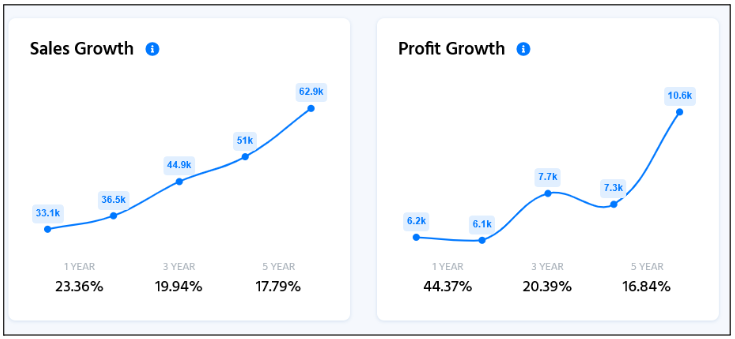
On a Consolidated basis
Over the last five years,
-
Bajaj Auto’s revenue increased from around ₹27,741 Cr. in FY21 to ₹62,905 Cr. in FY26, a CAGR of 17.79%.
-
Operating profit grew faster, from around ₹4,938 Cr. to ₹13,097 Cr., a CAGR of 22% over the same period.
-
Net profit increased from around ₹4,857 Cr. in FY21 to ₹10,574 Cr. in FY26, with a CAGR of 16.84%.
-
Operating margin improved from ~18% in FY21 to ~21% in FY26.
Source: Finology Ticker
Bajaj Auto remained debt-free on a standalone basis, with surplus cash and investments of ₹18,137 Cr. in FY26.
Operating cash flow increased from ₹7,267 Cr. in FY25 to ₹8,961 Cr. in FY26, equivalent to around 91% of net profit. With annual capex of about ₹500 Cr., Bajaj generated free cash flow of ₹13,443 Cr. over the last 5 years, allowing it to fund expansion and shareholder payouts without relying heavily on external debt.
Bajaj Auto spent approximately ₹501 Cr. on capital expenditure in FY26, less than 1% of its revenue. Its capital requirements are relatively low because most components are sourced from suppliers, with material costs accounting for around 70% of revenue. Bajaj mainly assembles vehicles at its existing, largely depreciated factories, while much of its capex goes towards tooling and equipment for new models.
Bajaj Auto had an annual production capacity of 72 lakh vehicles against sales of 51.2 lakh units in FY26. However, capacity shortages in Chetak, premium motorcycles and three-wheelers have led management to plan an expansion to over 90 lakh vehicles annually, which could increase capex.
The company has also arranged €880 million through equity and debt to support KTM’s restructuring. Along with the planned manufacturing capacity expansion, these investments could increase Bajaj’s capital requirements going forward.
Bajaj Auto ran on negative operating working capital of about ₹538 crore in FY26, excluding investments. In plain words, Bajaj’s suppliers fund its day-to-day operations. Inventory sits for about 19 days, and dealers pay in about 16, so cash comes back in roughly 35 days. Bajaj pays its suppliers in about 60 days.
This is common in India’s two-wheeler industry, mainly because large manufacturers have strong bargaining power. A handful of companies, including Hero, Honda, TVS and Bajaj, account for most of the industry’s sales. Many component suppliers depend on these manufacturers for a significant portion of their business, allowing manufacturers to negotiate longer payment periods and pay suppliers several weeks after receiving components.
On the other hand, dealers generally pay manufacturers before receiving vehicles, often using bank financing. They agree to these terms because dealerships are usually tied to a particular brand, customers visit showrooms for that brand, and manufacturers control the supply of vehicles to dealers. As a result, companies like Bajaj can collect money from dealers before paying their suppliers, keeping their working capital requirements low.
Coming to how Bajaj Auto compares against its peers
Hero and TVS Are the Main Competitors to Bajaj Auto in the 2W Space
| Parameter | Bajaj Auto | Hero MotoCorp | TVS Motor |
| FY26 vehicle volume growth | 10.00% | 9.70% | 24.10% |
| Vehicles sold FY26 (Lakh) | 51.2 | 64.7 | 58.9 |
| EBITDA per vehicle FY26 | ~23,500 | ~10,600 | ~10,300 |
| Domestic 2W market share (FY25 → FY26) | 11.4% → 10.5% | 28.8% → 28.4% | 17.5% → 18.9% |
| Electric 2W market share FY26 | 20.60% | 10.30% | 24.40% |
| Export contribution to volumes FY26 | 44.00% | 6.20% | 26.90% |
| Operating margin FY26 | 21% | 15% | 15% |
| ROCE FY26 | ~28% | ~35% | ~17% |
Bajaj Auto has the highest operating margin among its peers at 21%, compared with around 15% for Hero MotoCorp and TVS Motor. Its leadership in exports and three-wheelers gives it a more diversified business, which also supports its profitability.
However, Bajaj has consistently lost market share in the domestic two-wheeler market, while TVS has gained share and grown volumes much faster. TVS also has a stronger position in electric two-wheelers, where it has executed better than Bajaj.
On growth and competitive position, TVS currently appears better placed. Bajaj, however, continues to benefit from higher profitability, export leadership and strong cash generation.
Future Growth Opportunities
-
New motorcycle launches and market-share recovery
Bajaj is focusing on new motorcycle launches and upgrades to its existing Pulsar range to regain market share in India. The company plans to introduce new models and brands in the 125cc segment, where it has been losing ground to competitors. It is also increasing its focus on motorcycles above 150cc, where demand is growing faster than in entry-level motorcycles. The overall domestic motorcycle industry is expected to grow around 7-9% in the near term, with the 150cc+ segment expected to grow faster.
-
Export recovery and expansion in international markets
Bajaj plans to build on its export recovery by expanding its presence in Africa, Latin America and Asia. Management is targeting monthly exports of over 2.5 lakh vehicles, compared with an average of 1.88 lakh in FY26, implying growth of around 33%.
In Africa, Bajaj is focusing on affordable and durable motorcycles such as the Boxer 125 Heavy Duty to gain market share from Chinese manufacturers. In Latin America, it is focusing on higher-capacity motorcycles, particularly the Pulsar. The company is also expanding local manufacturing and distribution in Brazil to reduce import costs and support further growth.
-
Chetak expansion through new models and higher production capacity
Bajaj plans to increase Chetak’s monthly production capacity from around 50,000 to 60,000 scooters, a 20% increase. The company is also developing more affordable models to attract customers who currently prefer petrol scooters. Alongside new launches, Bajaj is improving battery and motor technology to cut costs and make Chetak more competitive.
Bajaj also plans to expand its exclusive Chetak store network from around 530-550 to approximately 1,000 over the next couple of years. This should help the company reach more customers in smaller cities and improve access to servicing and repairs, which are important factors for EV buyers. However, with increasing competition from TVS, Ather and other manufacturers, Bajaj will need to ensure that higher sales volumes also lead to better profitability.
-
Premium motorcycles
Bajaj plans to expand its KTM and Triumph businesses through new launches, wider distribution and greater localisation. The revised GST structure creates an opportunity, as motorcycles up to 350cc attract 18% GST, compared with 40% for those above 350cc.
By introducing 350cc variants, Bajaj can make KTM and Triumph motorcycles more affordable and compete more effectively with Royal Enfield. Higher production volumes and greater localisation could also help reduce costs and improve profitability.
However, reducing engine capacity may affect performance, particularly for KTM, which is known for its sporty motorcycles. Bajaj will need to balance pricing and performance while competing with Royal Enfield’s established brand and wide distribution network.
Coming to Key Risks
-
Dependence on exports and emerging-market currencies
Exports contributed approximately 35% of Bajaj’s standalone revenue in FY26, making international demand an important driver of earnings.
A large part of Bajaj’s export business serves developing countries across Africa, Latin America and Asia. These markets are often exposed to currency depreciation, inflation, political instability, and foreign-exchange shortages.
The consequences were visible between FY22 and FY24, when Bajaj’s total export volumes declined from 25.07 lakh to 16.36 lakh vehicles, a fall of nearly 35%.
Many overseas distributors require US dollars to import motorcycles. When local currencies depreciate, or dollars become difficult to obtain, distributors may reduce orders even when end-customer demand remains healthy.
-
Raw material inflation and margin pressure
Raw materials account for a substantial portion of Bajaj’s manufacturing costs. In FY26, material costs represented approximately 70% of standalone revenue, making profitability sensitive to changes in steel, aluminium, copper and other component prices.
The risk became particularly relevant ahead of FY27. Management highlighted sharp increases in several commodities, including approximately 15% in steel, 20% in copper and 35–45% in aluminium and certain precious metals.
Management estimated that these increases could translate into material-cost inflation equivalent to approximately 3.5–4% of revenue during Q1 FY27. Price increases implemented in April were expected to offset only around 40% of this impact initially.
-
Financing growth and credit quality
Bajaj Auto has rapidly expanded its vehicle-financing business through Bajaj Auto Credit Limited. Its loan book nearly doubled to ₹18,834.68 crore in FY26 and crossed ₹20,000 crore in Q1 FY27. The business helps Bajaj sell more vehicles by making loans available to customers, while also earning interest income. In Q1 FY27, it reported a profit of ₹227 crore, more than double the previous year.
The rapid growth of the financing business also brings the risk of loan defaults. Many two-wheeler and three-wheeler buyers have irregular incomes, which can make it difficult to repay loans during periods of financial stress. Bajaj Auto Credit’s gross NPA increased from 0.80% in FY25 to 1.85% in FY26, while credit costs, which measure losses from lending, rose from 2.4% to 3.5%..
If credit quality deteriorates as the loan book expands, higher provisions could reduce profits and increase the amount of capital required to support lending.
-
Dependence on PLI incentives and currency movements
Part of Bajaj’s recent margin improvement has come from government PLI incentives on electric vehicles, which increased from almost nil in FY24 to ₹467 Cr. in FY25 and around ₹900 Cr. in FY26. Excluding these incentives, its EBITDA margin was 19.2% in FY26, compared with 19.7% in FY24. The scheme ends in March 2028, which could affect profitability, as management has indicated that electric three-wheeler margins are comparable to petrol and CNG models only after including PLI benefits.
A weaker rupee has also helped Bajaj’s profitability. The average exchange rate on export revenue increased from ₹84.7 per dollar in FY24 to ₹90.6 in FY26. At FY24 exchange rates, FY26 export revenue would have been around ₹1,300 Cr. lower, with most of this benefit adding to profits. However, if the rupee stabilises or strengthens, this benefit could reduce.
Coming to Valuations
Bajaj Auto currently trades at around 23x earnings, approximately 15% above its historical median P/E of 20x. However, the stock’s P/E has fallen from around 40x in FY24 to 23x currently. This may partly reflect Bajaj’s declining domestic motorcycle market share, which fell from 18.2% in FY24 to 15.6% in FY26. The KTM acquisition has also increased capital requirements and created uncertainty around future profitability.
| Exit P/E after five years | PAT CAGR required for 15% return |
| 15x | 25.30% |
| 20x | 18.30% |
| 25x | 13.10% |
If Bajaj’s valuation returns to its historical median of 20x after five years, PAT would need to grow at approximately 18.3% CAGR for investors to earn a 15% annual return, excluding dividends.
At the same 20x exit multiple, 15% annual earnings growth would generate approximately 11.8% annual returns, while 20% growth would deliver around 16.7%.
For comparison, Bajaj Auto’s PAT grew at approximately 17% CAGR between FY21 and FY26. If the company maintains this growth rate over the next five years, investors could earn around 13.8% annual returns at an exit P/E of 20x, excluding dividends.
At around 23x earnings, the valuation appears reasonable but leaves limited room for weaker earnings growth. Future returns will depend on sustained profit growth, a recovery in domestic market share and the performance of its overseas investments.
In our opinion..
Bajaj Auto remains a strong business with high profitability, healthy cash flows, a strong export franchise and leadership in three-wheelers. However, its declining domestic motorcycle market share remains a concern, especially with increasing competition from Hero, Honda and TVS. At around 23x earnings, we see limited scope for significant valuation expansion and expect stock returns to largely track earnings growth. Given its strong business franchise but the need to regain market share, we maintain a HOLD view at current valuations.
Disclaimer
Investment in securities market are subject to market risks. Read all the related documents carefully before investing. The information and analysis provided herein are for educational and informational purposes only and do not constitute investment advice, a research recommendation, or an offer, solicitation, or recommendation to buy, sell, or hold any security. Investors should exercise their own judgment, conduct independent due diligence, and consult professional advisers before making investment decisions. Finology Ventures Private Limited, its affiliates, directors, employees, and research analysts shall not be liable for any loss or damage arising from the use of or reliance on this information.