


/offerpages/6a4d71ea88e54c748ee5543390d949a8.jpg) Finology
Finology
 09 Sep 2026
 Table of Content

Hello!
Today’s edition is about a business often misunderstood as “just an AC company”.
For perspective, 54.5% of the company’s FY26 revenue came from Electro-Mechanical Projects and Commercial Air Conditioning Systems. And that’s why we thought it was worth dissecting fully for you.
One thing I’d love to hear from you before that: which business or theme should make it onto a future DeepScan, and why? Tell me in the comments below.
Note: This DeepScan is an educational analysis, not a stock recommendation. Its purpose is to help you learn how we analyse businesses. If you’re looking for actionable stock recommendations, explore Finology 30.
In the previous DeepScan, we discussed Cummins India, a company set to benefit from India’s data-centre boom. Blue Star can also benefit from the same theme, but from a different part of the value chain.
For Blue Star, this opportunity comes mainly through two areas: Electro-Mechanical Projects and commercial cooling equipment such as chillers. Let’s build on that.
Blue Star’s business segments
Blue Star operates across three core business segments.
| Segment | FY26 Revenue | Revenue share |
| Electro-Mechanical Projects & Commercial Air Conditioning Systems | ₹6,762.8 Cr. | 54.50% |
| Unitary Products | ₹5,332.4 Cr. | 43.00% |
| Professional Electronics & Industrial Systems | ₹306.8 Cr. | 2.50% |
| Total | ₹12,402 Cr. | 100% |
1. Electro-Mechanical Projects: Building the Infrastructure Inside Large Facilities
Strip away the jargon, and it is essentially Blue Star’s large project execution business.
When a data centre, factory, hospital, airport or commercial building is constructed, the building itself is only one part of the project. It also needs electrical systems, cooling and ventilation, water supply, drainage, firefighting systems and other supporting infrastructure before it can actually operate.
Take a data centre as an example. Electricity needs to reach different parts of the facility, cooling systems have to control temperature, pipes are needed for water and drainage, and fire-protection systems have to be installed.
Blue Star can take responsibility for setting up these systems and making sure they work together.
The mechanical part mainly includes cooling and ventilation systems. The electrical part includes systems used to distribute power across the facility, while the plumbing part covers water supply, drainage and related piping. In many projects, Blue Star also handles firefighting and other building systems.
Data Centres Are Becoming a Much Bigger Part of the Project Business
Until recently, data centres were just one of several end-markets for Blue Star, alongside commercial buildings, factories, hospitals and infrastructure projects. That mix is now beginning to change.
In FY26, Blue Star generated roughly ₹1,000 crore of revenue from data-centre Mechanical, Electrical and Plumbing (MEP) projects alone. This was around 8% of the company’s total revenue and roughly 15% of EMP and commercial air conditioning systems segment revenue.
The company holds around 30% market share in data-centre Mechanical, Electrical and Plumbing projects, making it the market leader in this segment.
The opportunity itself is expanding rapidly. India’s data-centre Mechanical, Electrical and Plumbing market is estimated at around ₹3,500 crore in FY26 and is expected to reach nearly ₹7,000 crore by FY29, at a CAGR of roughly 26% over the next three years.
The momentum became much more visible in Q1 FY27. The company received close to ₹1,500 crore of data-centre MEP orders in just one quarter, while total order inflow for the entire Electro-Mechanical Projects and Commercial Air Conditioning Systems segment was ₹2,435 crore.
This means data centres alone accounted for roughly 62% of the segment’s quarterly order inflow.
And the company expects this business to scale rapidly from here:
-
FY27: Data centre MEP order inflow of around ₹3,000 crore, with revenue of roughly ₹1,350-1,400 crore.
-
FY28: Order inflow of around ₹4,500 crore, with revenue reaching approximately ₹2,100 crore
-
FY29: Data centre MEP revenue could reach around ₹4,000 crore, contributing close to 20% of Blue Star’s total revenue
If this plays out, data-centre MEP revenue would increase roughly 4x between FY26 and FY29.
Demand has become strong enough that some data-centre operators are looking to block vendor capacity and discuss multi-year contracts. Blue Star is also moving manpower and resources away from some traditional infrastructure and building projects towards data centres to meet this demand.
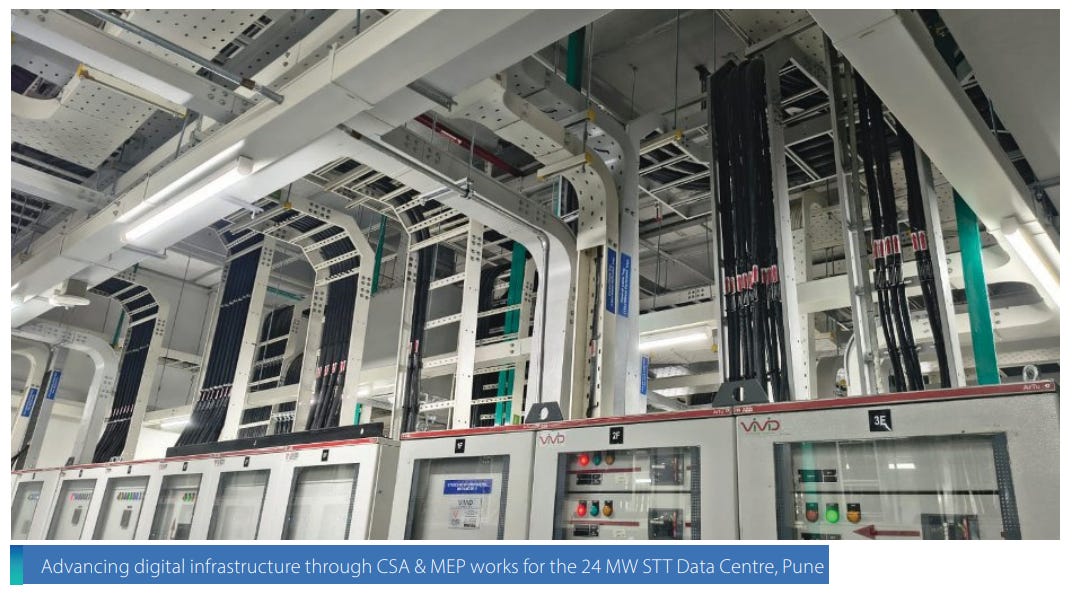
The economics of these projects also appear attractive.
A typical Blue Star data-centre MEP project is completed in around 8-12 months, while infrastructure projects such as metro rail, railway electrification and water projects can take 3-5 years.
Now, because of that shorter execution cycle:
-
Blue Star can complete projects and redeploy its teams much faster.
-
Payments are received over a shorter period, improving cash-flow visibility.
-
Capital and manpower remain tied up for less time.
-
The risk of cost overruns during the final stages of execution is lower.
The difference becomes particularly important because infrastructure is among the lowest profitability areas within Blue Star’s project business. As multi-year infrastructure projects move towards completion, additional costs can arise during closure and handover, putting further pressure on margins. Blue Star has therefore become increasingly selective about such projects.
Data-centre contracts offer better protection. Payment terms are relatively favourable, and contracts generally contain price escalation clauses for metals and electrical items. So if copper, steel or other input costs rise during execution, Blue Star has greater ability to pass those increases through instead of absorbing the entire impact itself.
This is why Blue Star has deliberately been prioritising businesses such as factories, data centres, hospitals and organised retail over conventional infrastructure projects. These projects generally offer a combination of better margins, shorter turnaround periods, stronger counterparties and healthier cash flows.
2. Commercial Air Conditioning Systems
Blue Star designs, manufactures, sells, installs and services large air-conditioning systems used in places such as factories, hospitals, hotels, shopping centres, offices, educational institutions and data centres.
The product portfolio broadly includes ducted and packaged air-conditioning systems, Variable Refrigerant Flow systems and different types of chillers, including scroll, screw, centrifugal and specialised data-centre chillers.
The easiest way to understand these products is through the size and complexity of the cooling requirement.
-
Ducted and packaged systems use a central AC unit and distribute conditioned air through ducts across larger spaces.
-
VRF systems allow different rooms or zones to be cooled independently while connecting multiple indoor units to a larger outdoor system.
-
Chillers come into play when cooling requirements become much larger or more specialised, such as in factories, hospitals, large commercial buildings, and data centres.
India’s commercial air-conditioning market is around ₹5,500 crore in FY26, and the industry grew by about 9% during the year. Demand came from industrial facilities, hospitality, healthcare, government projects and infrastructure.
Management has indicated that commercial air conditioning can grow at around 10-12% CAGR over the medium term, largely alongside India’s construction, manufacturing and infrastructure cycle.
To put that into perspective, if a ₹5,500 crore industry grows at 10-12% annually, it could become roughly an ₹8,000-8,700 crore market by FY30.
The interesting part is that Blue Star is already one of the strongest commercial cooling companies in India.
In FY26, the company had:
-
53% market share in ducted air-conditioning systems
-
48% market share in scroll chillers
-
19% market share in VRF systems
-
20% market share in screw chillers
Manufacturing is becoming an important growth driver
As India adds semiconductor plants, electronics factories, electric-vehicle and battery facilities, solar-cell manufacturing plants, and other sophisticated factories, cooling requirements are becoming more complex.
Management has specifically highlighted semiconductor, EV battery and solar-cell manufacturing as areas creating opportunities for specialised air conditioning and cooling solutions.
A normal office may mainly require comfortable temperatures for employees. A semiconductor or electronics factory requires far more precise control over temperature, humidity and air quality because the manufacturing process itself depends on those conditions.
So unlike room air conditioners, where demand can move sharply depending on how hot the summer is, commercial air conditioning is more closely linked to factory construction, commercial real estate, hospitals, hotels, infrastructure and corporate capital expenditure.
Data centres create another opportunity through chillers
The opportunity is already meaningful. India’s conventional data-centre chiller market is at roughly ₹1,250-1,500 crore.
Blue Star has been expanding its portfolio specifically for this opportunity. In 2024, it added data-centre chillers, centrifugal chillers and brine chillers to its commercial cooling portfolio.
The company has around 10-12% market share in this segment.
It is also expanding the distribution and manufacturing infrastructure behind its Commercial Air Conditioning business.
During FY26, Blue Star added 57 dealers and entered 11 new towns for its Commercial Air Conditioning business. It also localised the manufacturing of Variable Refrigerant Flow cassette indoor units at its Sri City plant.
Product development has also remained a major focus. The company continues to invest in improving the electronics, reliability and energy efficiency of its ducted systems, Variable Refrigerant Flow systems and chillers. Its air-cooled and water-cooled chiller testing facilities at Wada are certified by the Air Conditioning, Heating and Refrigeration Institute, while Blue Star operates a broader research and development team of nearly 500 professionals across its cooling businesses.
The combination of product development and market-share gains is important because the commercial cooling industry is gradually moving towards more sophisticated systems. Customers increasingly require higher energy efficiency, automation, electronic controls and specialised cooling depending on the application.
The importance of these businesses within Blue Star has increased considerably over the past few years. Revenue from the Electro-Mechanical Projects and Commercial Air Conditioning Systems segment rose from around ₹4,016 crore in FY23 to ₹6,763 crore in FY26, a CAGR of roughly 19%.
The segment contributed around 50% of total revenue in FY23, compared to 54.5% in FY26.
In comparison, the Unitary Products segment, which includes room air conditioners and commercial refrigeration, contributed around 43% of revenue in FY26.
3. Unitary Products (Room ACs & Refrigeration): The Consumer-Facing Side of Blue Star
This is primarily a product business. Blue Star manufactures and sells room air conditioners, commercial refrigeration products and air coolers.
It sells them through dealers, distributors, large retailers and institutional customers, and provides after-sales service.
Room Air Conditioners: The Largest Consumer Business
This is the business most people associate with Blue Star.
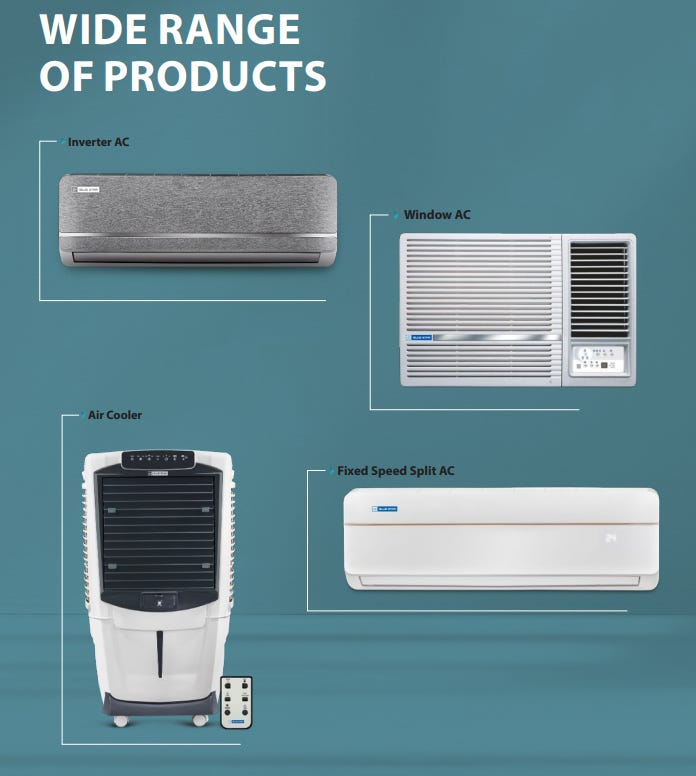
The company entered residential air conditioning only in 2011, much later than several established competitors, but has steadily gained market share since then. Today, it sells inverter split ACs, fixed-speed ACs, window ACs and a wide range of premium and entry-level models across different price points. Its FY26 portfolio included around 125 models, of which nearly 50 were Wi-Fi-enabled.
The Indian opportunity is large because air-conditioner penetration is still low. Blue Star estimates household penetration at only around 10%, meaning most Indian households still do not own an AC.
India’s room air-conditioner market was around ₹30,000 crore in FY26, with industry volumes at roughly 1.45-1.48 crore units. The market is expected to reach around 3 crore units annually by FY30, meaning volumes would roughly double in four years and implying growth of around 19-20% CAGR.
Blue Star’s market share in room air conditioners has steadily improved over the past few years. Its value market share increased from around 13.25% in FY22 to around 14.25% in FY26.
A major part of the next leg of growth is expected to come from smaller cities. Management believes Tier-3, Tier-4 and Tier-5 markets could eventually account for close to 70% of demand, where AC penetration is significantly lower, and the consumer is generally more focused on entry-level, value-for-money products.
Commercial Refrigeration: Smaller, but Blue Star Is Already a Leader
The easiest way to understand this business is to think about all the cooling equipment used by businesses.
An ice-cream shop needs a deep freezer, a restaurant needs refrigerated storage, a supermarket needs display coolers and freezers, a hospital may need specialised refrigerators for medicines and vaccines, a hotel or office may need water coolers and dispensers, and warehouses and food companies may need large cold rooms.
Blue Star supplies products across all of these categories.
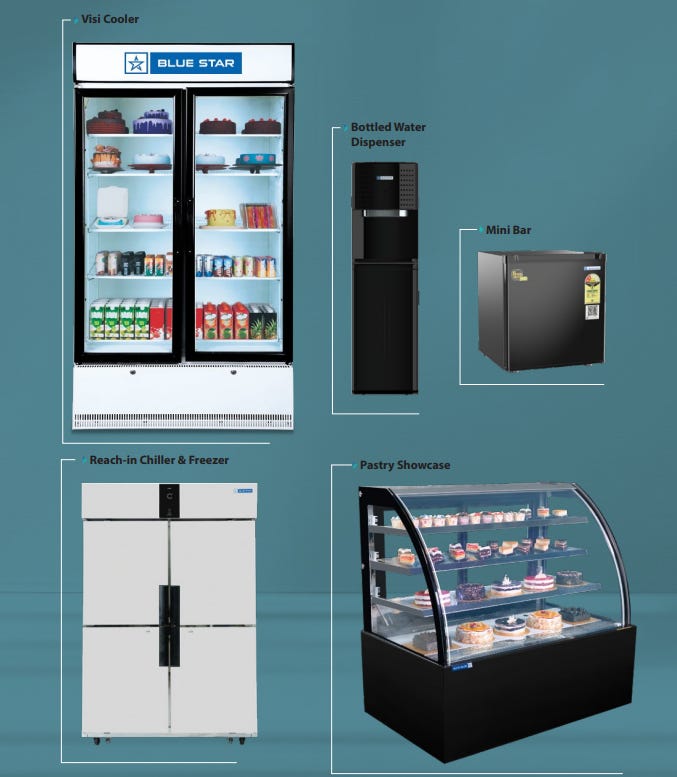
Its portfolio includes deep freezers, storage water coolers, bottled water dispensers, visi coolers and freezers, modular cold rooms, kitchen refrigeration equipment, supermarket refrigeration systems and specialised healthcare refrigeration products.
India’s commercial refrigeration market is around ₹5,400 crore in FY26, rising to roughly ₹6,700-7,000 crore by FY28.
The company’s market share is at around 31% in deep freezers and around 32% in modular cold rooms, while Blue Star also holds a leadership position in storage water coolers.
The economics of Unitary Products are very different from the project business
Unitary Products is fundamentally a volume, brand and distribution business.
In Electro-Mechanical Projects, Blue Star wins a ₹500 crore or ₹1,000 crore contract and earns revenue as the project gets executed.
In room air conditioners and commercial refrigeration, growth depends on how many products Blue Star can sell, the price at which it sells them, its distribution reach, market share and manufacturing cost.
That creates significant operating leverage.
When volumes are strong, manufacturing plants operate at higher utilisation and fixed expenses such as advertising, sales teams, research and development and distribution get spread across more units. This can lift margins quickly.
For example, Segment’s EBIT margin reached 10.4% in Q4 FY26, compared with 8.4% in the previous year, helped by better volumes, pricing discipline and lower discretionary spending. For FY26 as a whole, however, the segment margin was around 8.2%.
In data-centre MEP, Blue Star benefits from a rapid infrastructure capex cycle. In Unitary Products, the opportunity comes from low consumer penetration, distribution expansion, market-share gains and rising organised consumption across food and refrigeration categories.
4. International Business
Blue Star’s international business sits within its Electro-Mechanical Projects and Commercial Air Conditioning Systems segment, but the business model differs by geography.
In markets such as the Middle East, Africa, South Asia and Southeast Asia, Blue Star largely sells air-conditioning and refrigeration products through distributors and also undertakes some commercial cooling and project work. The company now exports its products and solutions to more than 20 countries.
The more interesting opportunity, however, is in the United States and Europe.
Here, it follows a custom Design Manufacturing model. In simple terms, an established overseas brand tells Blue Star what kind of product it needs, including the capacity, features and specifications. Blue Star then designs and manufactures that product in India and supplies it to the customer, which sells it under its own brand.
The products being developed for these markets include air-to-air heat pumps, air-to-water heat pumps, refrigeration condensing units and modular chillers.
The business has already started scaling. Total exports were around US$80-85 million in FY26, equivalent to roughly ₹760-808 crore.
The company is targeting another step-up from FY28, with plans to generate an additional US$100 million, or roughly ₹950 crore, of annual export revenue as customer approvals translate into larger orders.
5. After-Sales Service: Earning From the Installed Base
Once Blue Star installs a chiller, central air-conditioning system or other cooling equipment, the relationship with the customer does not necessarily end with the original sale. These systems need regular servicing, maintenance, repairs, replacement of parts and, eventually, upgrades.
Blue Star currently maintains around 2 million tonnes of air-conditioning and refrigeration equipment, giving it a large installed base from which it can generate repeat service business.
The company provides regular servicing as well as retrofits, system upgrades, duct cleaning and operations and maintenance services for electro-mechanical equipment.
To support this, Blue Star operates 33 spare-parts centres across India and electronic repair laboratories at 14 locations. It has also invested in remote monitoring, digital service platforms and a customer-management system to improve response times and track equipment throughout its life.
6. Professional Electronics & Industrial Systems
This is Blue Star’s smallest segment, contributing only around 2.5% of consolidated revenue in FY26.
The segment has three main businesses: Med-Tech Solutions, Industrial Solutions and Data Security Solutions.
Med-Tech mainly supplies specialised medical equipment used by hospitals and diagnostic centres. Industrial Solutions provides testing and measurement equipment used by industries such as automotive, steel and manufacturing. Data Security Solutions provides security-related systems and solutions mainly to banks and large companies.
Want to know how Finology 30 stocks have performed over time?
Opt in and get our detailed performance report straight to your inbox.
On a consolidated basis…
Over the last five years,
-
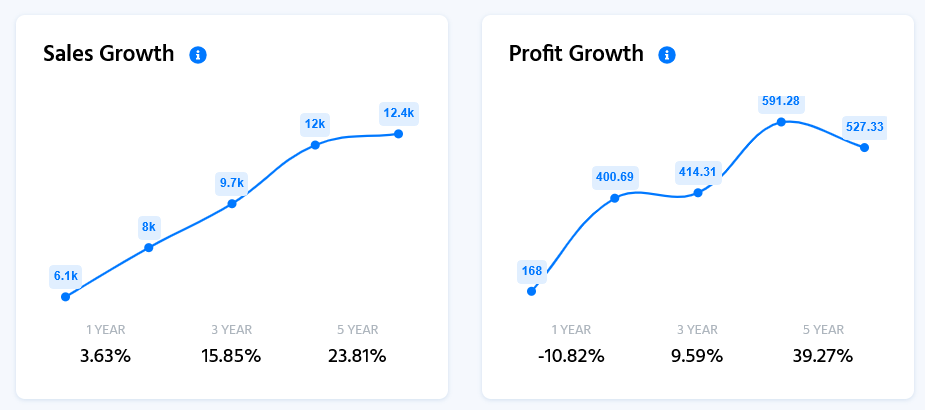
Blue Star’s revenue increased from around ₹4,264 Cr. in FY21 to ₹12,402 Cr. in FY26, a CAGR of roughly 23.81%.
-
Operating profit grew faster, from around ₹240 Cr. to ₹933 Cr., a CAGR of roughly 31.2% over the same period.
-
Net profit increased from around ₹101 Cr. in FY21 to ₹527 Cr. in FY26, with a CAGR of roughly 39.27%.
-
Operating margin improved from around 6% in FY21 to 8% in FY26.
(Source - Finology Ticker)
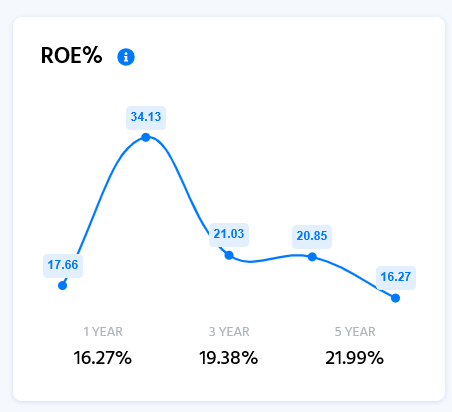
ROE declined from 34.13% in FY23 to 16.27% in FY26.
(Source - Finology Ticker)
Part of the decline in ROE is also because Blue Star is still in an investment phase. The company raised ₹1,000 Cr. through a Qualified Institutional Placement in FY24, which increased its equity base significantly.
At the same time, capital employed increased from around ₹2,427 Cr. in FY25 to ₹3,258 Cr. in FY26 as the company invested in manufacturing capacity, research and development, new cooling products and exports. As these investments start contributing more revenue and profit, return ratios could improve.
The balance sheet remains comfortable, with no long-term debt and a total debt-to-equity ratio of around 0.24.
Blue Star’s Growth Opportunities
Beyond the larger opportunities in data centres and infrastructure that we have discussed above, it has a few smaller growth levers that can become meaningful over time.
-
Liquid cooling could become the next leg of the data-centre opportunity
As AI servers become more powerful and generate more heat, liquid cooling and Cooling Distribution Units could gradually become more important. Blue Star is currently exploring technology partnerships across different countries for these products. At the same time, it is developing several data centre cooling products in-house, with some models already at an advanced stage of development. In Q3 FY26, the company indicated that these products could take around 12 months to become ready.
-
Semiconductor, battery and solar factories
Another growth opportunity is coming from new manufacturing sectors such as semiconductors, EV batteries and solar cells. These facilities need more specialised air conditioning and cooling solutions than a normal factory. Blue Star already has several projects under execution and more orders in the pipeline. The company expects demand from these sectors to grow strongly over the next 3-5 years.
-
Commercial air conditioning can penetrate deeper into Tier 3-5 India
Another growth opportunity is coming from smaller cities. Commercial air conditioning is no longer limited to large offices and malls in metros. More restaurants, hotels, hospitals, shops and other commercial establishments in Tier 3, 4 and 5 cities are getting air-conditioned. This, along with growth in manufacturing and infrastructure, should support steady demand for commercial cooling. The industry is expected to grow at around 8-10% over the medium term.
-
The export opportunity
Global customers in the US and Europe are looking to reduce their dependence on China and add another manufacturing source. This creates an opportunity for Indian manufacturers, especially because many large global AC companies also compete directly with these customers, making an independent supplier more attractive. Blue Star has already developed and tested heat pumps for these markets, and commercial shipments have started.
On capex plans…
Blue Star has invested around ₹1,140 Cr. over FY24-FY26, mainly in manufacturing capacity, R&D, new products and digitalisation. Another ₹300-350 Cr. of growth-related spending is planned for FY27.
Some of these investments have already started contributing. Room AC capacity at Sri City has ramped up, while new chillers and commercial cooling products are already being sold. But areas such as heat-pump exports and newer data-centre cooling technologies are still at an early stage.
So, part of the investment has already started generating revenue, while the full benefit of some newer products is still to come. Along with growth in room ACs and commercial cooling, this supports the company’s broader aim of increasing revenue from around ₹12,400 Cr. in FY26 towards ₹20,000 Cr. over the next few years.
Coming to how Blue Star compares against its peers…
Voltas is the closest listed peer to Blue Star because the two companies compete across most of the same businesses, including room air conditioners, commercial air conditioning, chillers, commercial refrigeration and electro-mechanical projects.
| Metric | Blue Star | Voltas |
| FY26 Revenue | ₹12,402 Cr. | ₹14,244 Cr. |
| FY26 Operating margin | 7.50% | 3.60% |
| FY26 PAT margin | 4.30% | 2.60% |
| FY26 ROE | 16.27% | 5.74% |
| Consumer/Unitary products share of revenue | ~43% | ~67% |
| project exposure | ~54.5% | ~28.4% |
| FY26 Unitary Products EBIT margin | 8.20% | 3.20% |
| FY26 project segment margin | 7.40% | 7.40% |
| Room AC market share | ~14% | ~17% |
| P/E ratio | ~58x | ~84x |
Evidently so, Voltas is the stronger consumer cooling player, with a larger room AC presence and a much higher dependence on the consumer segment. Blue Star, on the other hand, has a more diversified mix, with greater exposure to commercial cooling, electro-mechanical projects and other B2B businesses.
Views on the management…
Blue Star’s management and governance track record looks broadly clean. We did not find any major red flags around promoter pledging, auditor exits or regulatory action in recent years. Promoter shares also remain unpledged.
However, a few areas are worth monitoring.
In FY26, Vir Advani’s remuneration was around 127x the median employee remuneration, while B Thiagarajan’s was around 103x. High remuneration is not a governance issue by itself, but it can become one if management pay keeps increasing without similar improvement in profits, cash flows or shareholder returns.
There has also been one clear capital-allocation miss in the past. Blue Star decided to exit its Oman joint venture in FY19 and has fully impaired its investment of around ₹4.3 Cr.
Overall, we do not see any major governance concerns at present. Capital allocation has largely remained within the core cooling, manufacturing and project businesses.
Talking about the key risks
-
Room AC growth may not translate into higher margins
Competition in room ACs is increasing as more companies add manufacturing capacity and fight for market share. At the same time, a large part of new demand is coming from price-sensitive customers, which limits how much companies can raise prices. Industry operating margins, which were once around 12%, have already fallen to roughly 7.5-8%, and could remain around these levels. So even if room AC volumes continue to grow, strong revenue growth may not translate into equally strong profit growth.
-
Data-centre cooling technology could move faster than Blue Star’s capabilities
Indian companies are currently stronger in conventional air- and water-based cooling, but as AI servers become more powerful and generate more heat, technologies such as liquid cooling and direct-to-chip cooling could gradually become more important.
Blue Star is still building capabilities in some of these newer technologies. The company has said it is exploring technology tie-ups for liquid cooling and Cooling Distribution Units. If this market develops faster than expected and Blue Star is slow to build or acquire the required technology, it could lose market share in the cooling segment.
-
Dependence on imported components and external suppliers
Blue Star depends on imported and concentrated suppliers for several key components. Around 40% of the bill of materials is still imported, including parts such as compressors, copper tubes and electronics. The company also does not manufacture compressors itself and depends on outside suppliers. So, if the rupee weakens or global component prices rise, costs can go up quickly. Localisation is improving, but this is still an important risk as the room AC business grows.
-
Data-centre growth may not be smooth
Data centres are currently one of the biggest growth drivers, but this growth may not continue in a straight line. Even the company expects the segment to go through cycles, with periods of strong ordering followed by slower phases. As data centres become a larger part of revenue, any slowdown in new capacity additions could have a bigger impact on Blue Star’s growth.
Now, valuations.
Blue Star currently trades at around 58x earnings, which is about 21% above its historical median P/E of around 48x.
| Exit P/E after five years | PAT required for 15% return |
| 40x | 23.9% CAGR |
| 48x | 19.4% CAGR |
| 55x | 16.2% CAGR |
If Blue Star’s valuation returns to its historical median of 48x over the next five years, PAT will need to grow at around 19.4% CAGR for investors to earn a 15% annual return, excluding dividends. At the same exit valuation, 20% PAT growth would generate an annual return of around 15.5%, while 25% growth would increase it to roughly 20.4%.
Blue Star deserves some valuation premium because of its diversified business, strong position in commercial cooling and MEP, growing exposure to data centres and a comfortable balance sheet. However, at around 58x earnings, the stock already factors in strong profit growth for the next several years.
In our view…
Blue Star has several growth opportunities across data centres, commercial cooling, room ACs, refrigeration and exports. Its strong position in the B2B market and comfortable balance sheet also work in its favour.
However, competition in room ACs could keep margins under pressure. The company will also need to build capabilities in newer technologies such as liquid cooling to remain relevant in data-centre cooling. Since a large part of its business comes from projects, timely execution and working capital management will remain important.
Disclaimer
Investment in securities market are subject to market risks. Read all the related documents carefully before investing. The information and analysis provided herein are for educational and informational purposes only and do not constitute investment advice, a research recommendation, or an offer, solicitation, or recommendation to buy, sell, or hold any security. Investors should exercise their own judgment, conduct independent due diligence, and consult professional advisers before making investment decisions. Finology Ventures Private Limited, its affiliates, directors, employees, and research analysts shall not be liable for any loss or damage arising from the use of or reliance on this information.