


History & Evolution of India’s Two-Wheeler Industry: Finology DeepScan
/offerpages/6a4d71ea88e54c748ee5543390d949a8.jpg) Finology
Finology
 06 Oct 2026
 Table of Content
- How India’s two-wheeler industry began in the 1950s and 1960s
- The rise of family scooters in India during the 1960s and 1970s
- How Japanese partnerships changed India’s two-wheeler industry
- The 1990s: Hero Honda Splendor and TVS Scooty
- The 2000s: Bajaj Pulsar, TVS Apache, and Honda Activa
- How 70 Years Transformed India’s Two-Wheeler Industry
- The future of India’s two-wheeler industry

Hello,
In this DeepScan, we look at how India’s two-wheeler industry evolved from a small, import-dependent market after Independence into the world’s largest two-wheeler market.
Note: This DeepScan is an educational analysis, not a stock recommendation. Its purpose is to help you learn how we analyse businesses. If you’re looking for actionable stock recommendations, explore Finology 30.
Ask people from different generations about the first two-wheeler they remember, and you will probably get very different answers.
For someone growing up in the 1970s or 1980s, it could be a Bajaj Chetak parked outside the house. The father rode it to work, children somehow found space in the front, and on weekends the same scooter carried the family to the market or a relative’s house. Years later, Hamara Bajaj captured this relationship perfectly. It was no longer just a scooter. It had become part of the Indian family.
For many families, the Luna was the first step up from a bicycle, made memorable by the simple “Chal Meri Luna” campaign.
Then Kinetic Honda arrived with electric start and no gears, looking almost futuristic beside the old metal scooters. Hero Honda made mileage an obsession. The RX100 became the bike young riders wanted, while the humble Splendor became the bike millions actually bought. Later, the Activa brought the automatic scooter back into almost every kind of Indian household.
These vehicles belonged to very different Indias.
That is what makes the history of the two-wheeler industry interesting. It is not only the story of Bajaj, Hero, TVS, Honda or Royal Enfield. It is also the story of the Indian middle class: what it could afford, where it wanted to go, and what it wanted from the vehicle parked outside its home.
1950s-1960s: India learns to build two-wheelers
In the early 1950s, spotting a motorcycle or scooter on an Indian road was still unusual. Personal transport for most families meant a bicycle, since motorised two-wheelers remained something few could afford or even find easily.
India had only around 27,000 registered two-wheelers in 1951, rising to about 41,000 by 1956.
India had another problem. It did not yet have the factories, suppliers or technical know-how to make motorcycles and scooters in large numbers. Importing finished vehicles was not a practical solution either, because India had very little foreign exchange and needed those scarce dollars and pounds for machinery, food, raw materials and other essential imports. So instead of depending on imports, the government increasingly pushed companies to manufacture vehicles in India, often with technology and support from foreign partners.
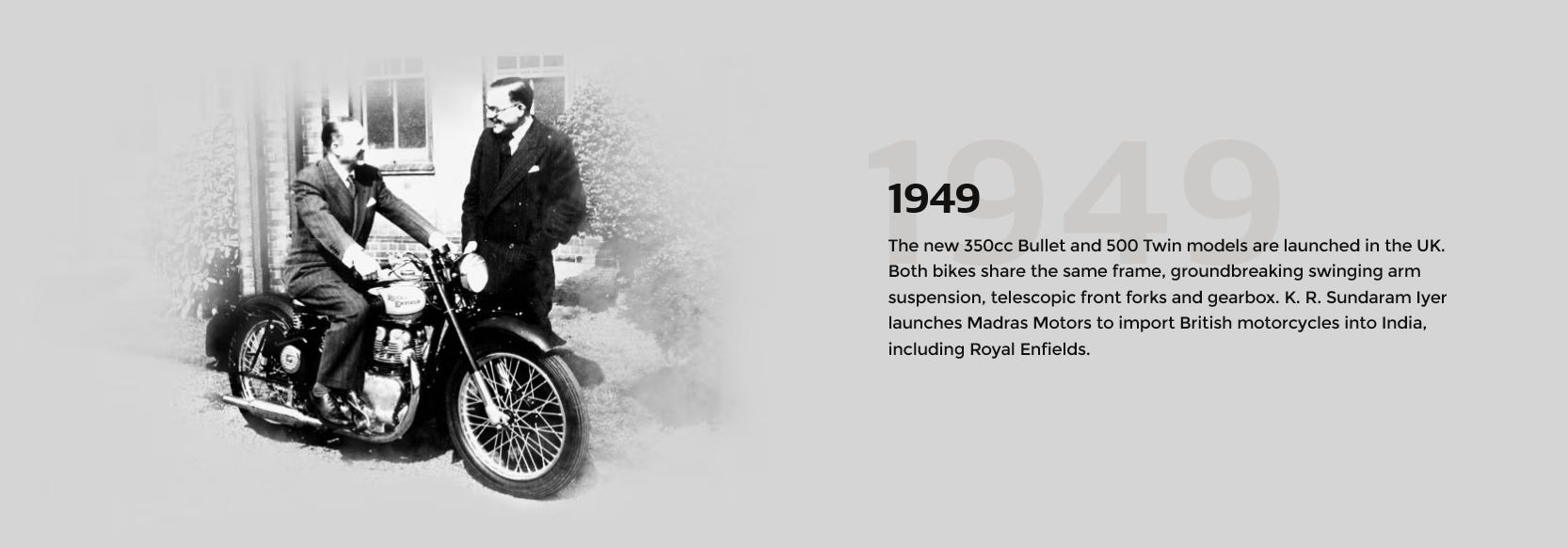
In 1949, K.R. Sundaram Iyer started Madras Motors and began importing British motorcycles, including Royal Enfield, Norton and Matchless. The Indian Army later ordered hundreds of 350cc Bullets for border patrols. Enfield India was formed in 1955, and by 1956 Bullets were being assembled at Tiruvottiyur near Madras from kits shipped from Britain. Over time, more of the parts began to be made locally.
Scooters followed a similar path. Automobile Products of India began producing the Lambretta with Italy’s Innocenti in 1955, while Bajaj, which had been importing two- and three-wheelers since 1948, received a manufacturing licence in 1959. A year later, it launched the Vespa 150 under licence from Italy’s Piaggio.
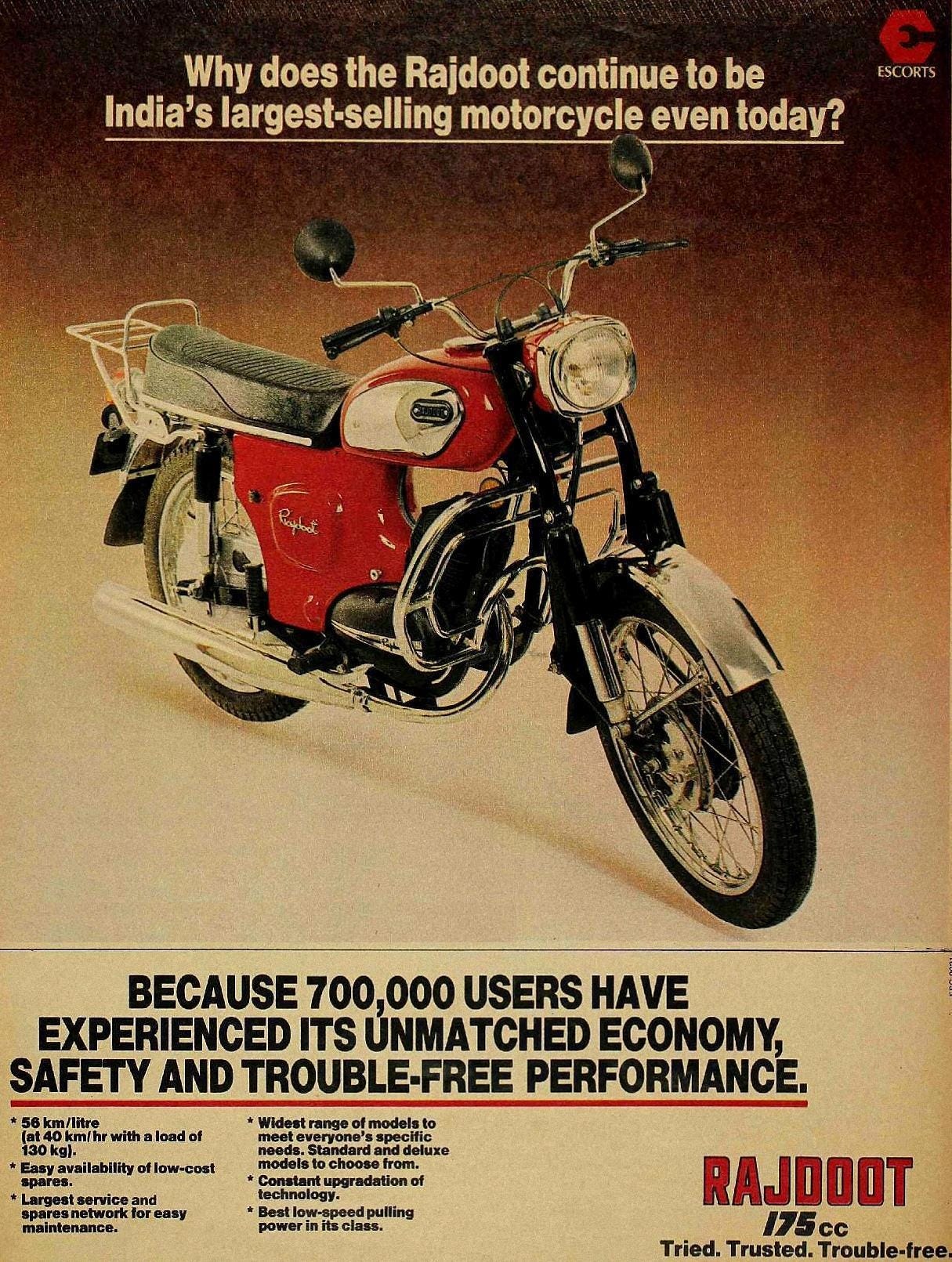
Then came motorcycles from other parts of Europe. Ideal Jawa brought Czechoslovakia’s Jawa to India, with its Mysore factory opening in 1961. Escorts followed with the Rajdoot 175, based on Polish motorcycle technology.
By the early 1960s, an Indian road could therefore have a British Bullet, an Italian Lambretta or Vespa, a Czechoslovakian Jawa and a Polish-derived Rajdoot. None of them had originally been designed in India.
That’s how India’s two-wheeler industry got started: foreign designs, Indian factories, and a country slowly learning how to build what it had once only imported.
India learns how to manufacture
The first few years were mostly about assembling foreign vehicles. But the real goal was always to manufacture more of them in India.
A motorcycle may look like one product, but it is really hundreds of different parts coming together: the engine, gearbox, frame, brakes, tyres, electricals, bearings and dozens of smaller components. India lacked a developed supplier base for many of these parts in the 1950s. So foreign partnerships mattered not just because they gave Indian companies a product to sell, but because they also brought designs, tooling, and manufacturing knowledge. Almost every major manufacturer entering between 1955 and 1969 had a foreign technical partner.
The government also pushed companies to gradually replace imported parts with locally made ones: Royal Enfield, for example, began with a five-year phased manufacturing programme. Similar localisation happened at API, Bajaj, Ideal Jawa and Escorts. As production increased, Indian companies making tyres, electrical equipment, castings and other components also became part of this growing ecosystem.
By 1966, around 91% of the 150cc Lambretta was already made in India. Rajdoot had reached 87.5% local content, Royal Enfield 350 around 83.5%, Bajaj’s Vespa 82.5%, and Jawa 75%.
It was the beginning of a capability that would matter far beyond these few brands. Decades later, India would become one of the world’s major two-wheeler manufacturing and export hubs. But the foundations were being laid in these small factories of the 1950s and 1960s.
1960s-1970s: The age of shortages and the family scooter
Today, buying a scooter is mostly about choosing the model, colour and price you like. In the 1960s and 1970s, the difficult part was getting one at all.
By the early 1970s, Bajaj had become one of the biggest names in India’s scooter market. It had started making the Vespa 150 with Piaggio in 1960 and was slowly moving ahead of Lambretta, its main rival. For many middle-class families, Bajaj was becoming the scooter they wanted to own.
Demand was growing much faster than production. In Delhi, the government estimated in 1963 that a customer could wait around 8 years for a Lambretta and 5 years for a Vespa. By 1966, the estimated wait had become even more extreme: around 20 years for a Lambretta and 11 years for a Vespa.
The waiting lists kept growing. A 1968 Lok Sabha debate noted that the government had been talking about roughly 3 lakh people waiting for scooters since 1964, while annual scooter production was only around 30,000 units.
For families, this made a scooter much more than another purchase. You booked one, waited for your turn and hoped your allotment came sooner rather than later. Getting delivery could become an event in itself.
The shortage also created a strange second market. By March 1970, pending bookings had reached 1,76,933 for Vespa/Bajaj scooters and 84,883 for Lambrettas. Someone lucky enough to receive a scooter could sometimes sell it immediately for as much as twice the official price. Dealers and brokers also earned premiums by helping buyers jump the queue.
There is a story from the same period that shows just how valuable an allotment had become. In the early 1970s, Air Chief Marshal Idris Latif, then commanding the Lohegaon Air Force base near Pune, wrote personally to Rahul Bajaj asking whether one of his employees could get a scooter on priority. The employee lived far from the base, needed to be available at short notice during a period of military alert, and had a severely disabled daughter. Bajaj approved the request.
The obvious question is: if so many people wanted scooters, why didn’t Bajaj and the other manufacturers simply make more?
Because under the Licence Raj, companies could not freely decide how much capacity to add. Expanding a factory required government approval, and access to imported machinery, components and foreign exchange was also controlled. Rahul Bajaj later recalled that from 1968 onward, his requests for higher capacity often received approval for only a fraction of what the company wanted.
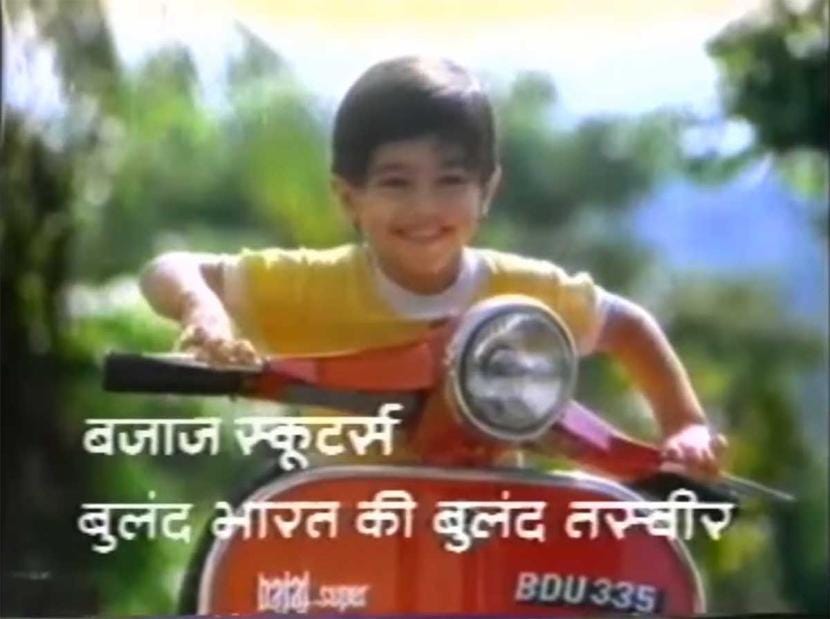
Out of this era of shortages and waiting lists emerged the scooter an entire generation would eventually remember simply as Hamara Bajaj.
1980s: The Japanese joint-venture revolution
For years, the Indian scooter had followed a familiar formula. It was heavy, made largely of metal, had gears on the handlebar and usually needed a good kick to start. Bajaj Chetak and its peers had become trusted family vehicles, but by the mid-1980s the basic scooter itself had not changed very much.
Then Japan entered the picture.
The 1980s brought a big change to India’s two-wheeler industry. Until then, most Indian vehicles were based on older European technology. But the government gradually allowed more foreign technical partnerships, and Japanese companies saw a huge opportunity:
-
India had a large population, and two-wheelers were fast becoming a key mode of transport.
-
Indian manufacturers still needed better technology, fuel efficiency and quality.
-
Foreign companies couldn’t freely set up their own businesses in India, so partnering with local firms was the way in.
| Japanese company | Indian partner | What the partnership became known for |
| Honda | Hero | Fuel-efficient four-stroke motorcycles such as the CD100 |
| Honda | Kinetic | Automatic scooters and electric start |
| Suzuki | TVS | Modern lightweight motorcycles and Japanese manufacturing know-how |
| Kawasaki | Bajaj | New-generation motorcycles such as the KB100 |
| Yamaha | Escorts | Performance motorcycles such as the RX100 |
Honda’s strategy shows how important the Indian market had become. In 1984, it established Hero Honda with the Hero Group for motorcycles and Kinetic Honda with Kinetic Engineering for scooters. Hero Honda began producing the CD100 in 1985.
TVS also partnered with Suzuki during this period, while Bajaj developed its technology relationship with Kawasaki. Yamaha entered into a technical-support arrangement with Escorts in the mid-1980s.
Kinetic Honda makes the old scooter look old
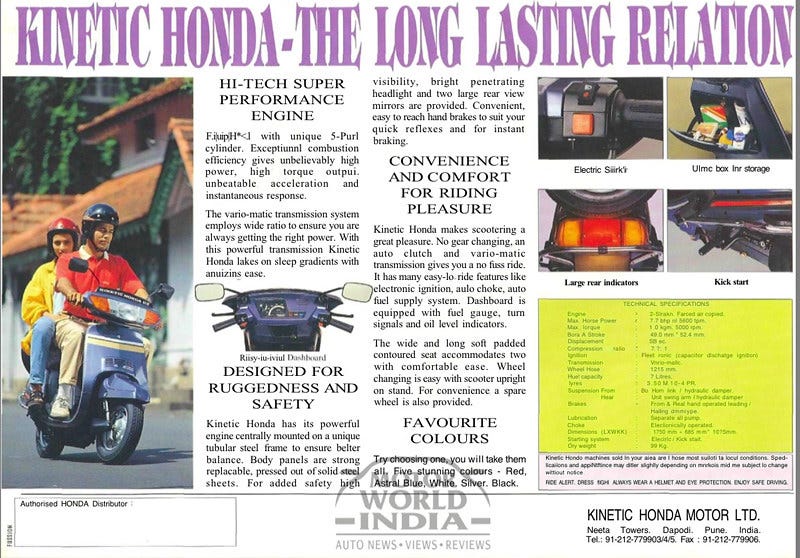
Honda formed Kinetic Honda with Pune-based Kinetic Engineering in 1984. Kinetic already knew the Indian market through the Luna, while Honda brought newer scooter technology from Japan. The Kinetic Honda that followed looked very different from the scooters Indians were used to. There were no gears to change; it had an automatic transmission, and most importantly, it could start with the press of a button.
That electric-start button may sound ordinary today, but imagine seeing it in the 1980s when starting a scooter often meant tilting it slightly, kicking the starter and hoping the engine came alive.
The design itself looked newer too. Old Kinetic Honda advertisements talked about things like electronic ignition, auto choke, a fuel gauge, and easy hand-operated brakes. The company was no longer selling only toughness. It was selling convenience.
There was also an interesting Indian touch behind the Japanese technology. Honda normally used more plastic on scooters in other markets, but for India it chose steel body panels. The reason was simple: Indian families often kept the same scooter for many years and wanted something the neighbourhood mechanic could repair rather than replace.
That combination helped open scooters to a wider group of riders. Accounts from the period and later industry histories note that Kinetic Honda became especially popular among teenagers and women, for whom an automatic transmission and electric start removed much of the effort involved in riding the older geared scooters.
And Kinetic wanted to prove that convenience did not mean weakness.
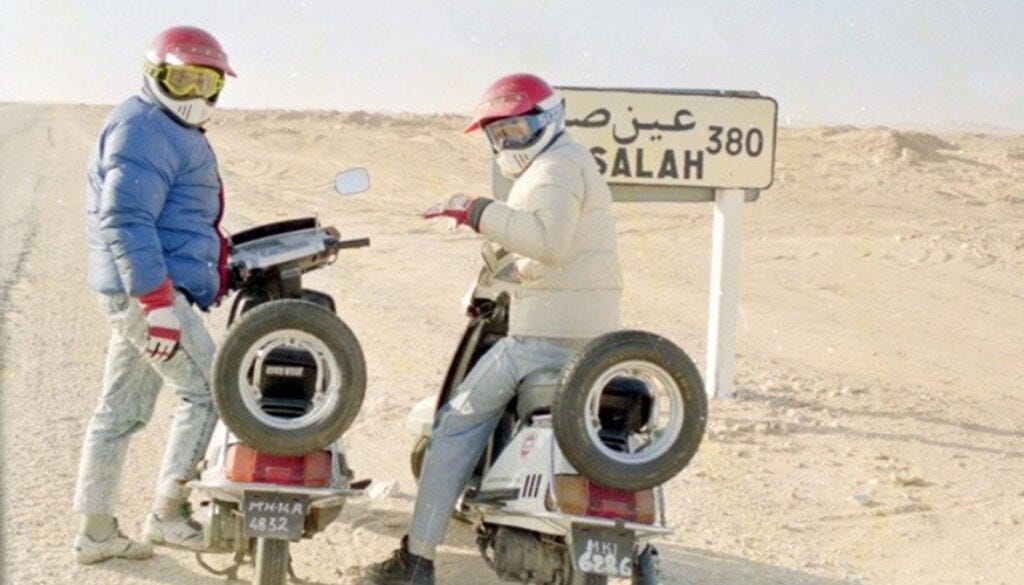
In December 1991, two Kinetic scooters were taken across the Sahara Desert, travelling about 6,100 km from Casablanca to Lagos in roughly three weeks. It was an unusual publicity stunt for a scooter associated with city commuting, but that was precisely the point: Kinetic wanted to show that the little automatic scooter could survive far more than the daily ride to the office or college.
Hero Honda changes the rules: mileage becomes everything.
By the early 1980s, the Indian two-wheeler market was changing again. For decades, buyers had worried mainly about whether they could get a scooter at all. But as production increased and new companies entered, the question slowly changed from “Can I get one?” to “Which one should I buy?”
Of all these partnerships, Hero Honda would change the market the most.
Kinetic Honda had changed what Indians expected from a scooter. Hero Honda would now do something even bigger to the motorcycle market.
Hero Honda was formed in 1984 between the Munjal family’s Hero Group, already one of India’s biggest bicycle makers, and Japan’s Honda. Their first motorcycle, the CD100, rolled out in 1985. It was a small 100cc four-stroke motorcycle at a time when most Indian motorcycles still used two-stroke engines. Honda brought the engine technology, while Hero brought something equally important: an understanding of the Indian customer and a distribution network that could eventually reach deep into smaller towns.
And the timing could hardly have been better.
Petrol prices had become an important concern for Indian households, making fuel efficiency increasingly important. Hero Honda arrived at exactly the right time with the fuel-efficient four-stroke CD100. Demand was huge from the beginning. By July 1985, the company had already collected around ₹25 crore as advance money against motorcycle bookings, according to a Lok Sabha reply.
Then came an advertising line that an entire generation would remember:
“Fill it. Shut it. Forget it.”
The idea was wonderfully simple. Fill the petrol tank, close it and stop worrying about fuel for a while. The campaign turned mileage from a brochure specification into the main reason to buy a motorcycle. The CD100 quickly became known for being cheap to run, dependable and easy to live with.
RX100 shows that a motorcycle could also be fun
Yamaha entered India with Escorts in the mid-1980s, and the RX100 arrived in during the same time. Its 98cc two-stroke engine produced around 11 bhp, compared with about 7.5 bhp from Hero Honda’s CD100. It was light, quick and had a distinctive exhaust note that became part of its identity. While Hero Honda was selling fuel economy to the family commuter, Yamaha deliberately positioned itself around power, speed and style.
For many young riders, it was the bike they wanted, not the bike they necessarily needed. Even Yamaha’s current management acknowledges that its combination of light weight, performance and sound helped turn the RX100 into an unusually strong cult brand in India.
1990s: Motorcycles take over, and a new rider emerges
The 1980s had introduced Indians to better technology.
The 1990s were about taking it to scale.
For Hero Honda, the breakthrough came in 1994.
Hero Honda understood the market best. Most Indians were not looking for the fastest motorcycle. They wanted something that started every morning, required little maintenance and did not drink petrol.
That idea was perfected in 1994 with the launch of the Splendor. It simply did its job extremely well. Over time, fuel efficiency, dependable quality, low running costs and resale value became almost inseparable from the Hero Honda name. By 2000, Splendor had become the world’s largest-selling two-wheeler model.
The Chetak generation had grown up asking how long they would have to wait for their scooter.
The Splendor generation started asking a different question:
“Kitna deti hai?”
And that change would eventually turn India from a country of scooters into a country of motorcycles.
But another important change was happening at the same time.
The industry was beginning to recognise women not just as passengers or occasional users, but as customers in their own right.
Scooty puts women in the rider’s seat
Women riding two-wheelers was not new.
Mopeds such as Luna had already provided relatively accessible personal mobility, and Kinetic Honda’s automatic transmission and electric start had made scooters much easier to use.
What TVS did differently was build an entire product and brand around the idea that a woman could be the primary buyer and rider.
TVS launched the Scooty in 1994.
Compared with the heavy geared scooters of earlier decades, Scooty was smaller, lighter and easier to manoeuvre.
TVS increasingly positioned Scooty around young women, particularly college students and working women. The vehicle was not presented simply as another family scooter. It was connected with independence, convenience and having your own mobility.
That positioning created a segment powerful enough that the brand name itself became closely associated with small automatic scooters.
By 2004, Scooty had crossed 10 lakh cumulative sales, while TVS said it controlled around 65% of the scooterette segment. The company described the vehicle as particularly popular among young college girls and working women.
By the end of the 1990s, therefore, the Indian two-wheeler market had changed enormously.
The commuter motorcycle had become mainstream.
Women were increasingly being targeted as independent riders.
And among younger buyers, another idea was beginning to emerge: a motorcycle could be more than economical transport.
It could also be aspirational.
That would shape the 2000s.
2000s: Performance rises, and the scooter comes back
Bajaj saw the change coming.
In 2001, when most of the motorcycle market was still dominated by 100cc commuter bikes, Bajaj launched the Pulsar 150 and 180. Instead of trying to beat Hero Honda at mileage, Bajaj deliberately went in the opposite direction. Rajiv Bajaj later described the difference simply: Hero owned mileage, while Bajaj wanted to own power.
The advertising made that change impossible to miss.
Hero Honda had told India: “Fill it. Shut it. Forget it.”
Pulsar arrived with “Definitely Male.”
That difference says a lot about how India itself had changed. The commuter motorcycle was still huge, but a motorcycle could now also be something a young person bought to express himself.
TVS followed this trend with the Apache in 2005, using its racing experience to sell performance, handling and sporty design. TVS itself described the original Apache as a bike aimed at youngsters looking for something aggressive and performance-oriented.
Within two decades, motorcycle advertising had moved from saving petrol to selling attitude.
The Indian two-wheeler was no longer just a vehicle that took you to work. Increasingly, it was becoming something you wanted to be seen riding.
The scooter comes back
By the late 1990s, it looked like the scooter had lost its place in India. Motorcycles had taken over because they offered better mileage, were easier to use on rough roads and suited both cities and smaller towns. Even Bajaj, the company that had once made the scooter almost a part of Indian family life, was slowly shifting its attention towards motorcycles.
But the idea of a modern, easy-to-ride scooter had not disappeared.
Kinetic Honda had already shown this in the 1980s. It introduced Indians to an automatic, gearless scooter with electric start, a clear break from the heavy Chetak-style scooters of the time, and it found a loyal following among younger riders and women. By the late 1990s, though, the company had started losing momentum. Sales weakened as competition grew, and Honda exited the joint venture in 1998. Kinetic carried on alone, but it never managed to turn the early promise of the automatic scooter into a mass-market product.
Honda, however, had not given up on the idea.
It set up Honda Motorcycle & Scooter India and launched the Activa in 2001. In many ways, Activa took what Kinetic Honda had started and made it work at a much larger scale. There were no gears or clutch to manage, it had a four-stroke engine, under-seat storage and enough space to carry groceries, bags or whatever else the family needed. Honda itself said the scooter market had become stagnant because buyers had not been offered enough new ideas.
The timing was also right. Cities were becoming more crowded, more women were travelling independently for work and education, and families increasingly wanted one vehicle that almost anyone at home could ride.
The response was quick. Activa crossed 1 lakh units of production within its first 15 months and soon captured more than 50% of India’s mid-size scooter market. Between 2001 and 2009, the first-generation Activa sold around 24.7 lakh units.
What made Activa different was that it did not belong to only one kind of rider. The father could take it to office, the mother could use it for shopping, and eventually the children could learn on the same scooter. Honda itself later described Activa as a vehicle commonly shared by different members of the family.
What 70 years created: the industry today
| Year | Vehicle | Why it mattered |
| 1955–56 | Royal Enfield Bullet | Early locally assembled motorcycle |
| 1960 | Bajaj Vespa 150 | Made scooters aspirational family transport |
| 1961 | Jawa | Built an early enthusiast following |
| 1962 | Rajdoot 175 | Rugged, practical motorcycle |
| 1972 | Bajaj Chetak | Became the defining family scooter |
| 1972 | Luna | Affordable step up from bicycles |
| 1979 | TVS 50 | Established TVS in mopeds |
| 1985 | Hero Honda CD100 | Made mileage a major selling point |
| 1986 | Yamaha RX100 | Became a cult performance motorcycle |
| Mid-1980s | Kinetic Honda | Brought automatic scooters and electric start |
| Year | Vehicle | Why it mattered |
| 1986 | Bajaj KB100 | Brought Kawasaki-backed technology |
| 1994 | Hero Honda Splendor | Took commuter motorcycles to mass scale |
| 1994 | TVS Scooty | Helped build the women-rider segment |
| 2001 | Honda Activa | Made automatic scooters mainstream |
| 2001 | Bajaj Pulsar 150/180 | Created mass-market performance biking |
| 2005 | TVS Apache | Strengthened the sporty motorcycle category |
| 2008 | Yamaha R15 | Brought advanced performance tech |
| 2018 | Ather 450 | Made connected electric scooters aspirational |
| 2020 | TVS iQube | Marked legacy players' serious EV push |
Seventy years after India was assembling imported motorcycles in small numbers, India has become the world’s largest two-wheeler market.
In FY26, domestic two-wheeler wholesales reached a record 2.17 crore units, up 10.7% YoY and finally crossing the previous peak of FY19.
-
Motorcycles still form the backbone of the market, with sales of about 1.31 crore units, or roughly 60% of total volumes.
-
Scooter sales grew 18.5% to 81.2 lakh units, taking their share to around 37%.
The market is also highly concentrated. According to FADA retail data for FY26, Hero MotoCorp remained the leader with 28.4% share, followed by Honda at 25.0%, TVS at 18.9%, Bajaj at 10.5% and Royal Enfield at 5.2%. Together, these five companies controlled nearly 88% of the market.
But the more interesting change is happening inside these volumes.
India is still largely a commuter market. Industry analysis estimates that economy and executive motorcycles together sold around 95 lakh units, compared with about 18 lakh premium motorcycles. So the Splendor-type buyer is still far more important than the superbike buyer.
But the direction is clearly changing. Premium motorcycle volumes grew around 14% in FY26, much faster than the roughly 3% growth in commuter motorcycles.
India has also become a major manufacturing base for the rest of the world. Two-wheeler exports reached a record 51.8 lakh units in FY26, up 23.4%, with Africa, South Asia and Latin America among the key markets.
In just a few decades, India went from barely having a two-wheeler industry to becoming the world’s largest two-wheeler market. What started with imported Bullets, Vespas and Jawas slowly turned into a huge domestic industry built around Indian factories, suppliers, brands and millions of everyday riders.
The next transition: premiumisation and EVs
The next phase of India’s two-wheeler market is already starting to look different from the old commuter-led model.
We can already see this in motorcycles. Bikes of 125cc and above made up around 26% of motorcycle sales in the first ten months of FY26, compared with 22.1% in FY20.
The second shift is electric.
Electric two-wheelers are probably the biggest change the industry has seen since automatic scooters became mainstream.
For most Indian buyers, the biggest reason to consider an EV is not technology. It is running cost. A typical petrol scooter giving around 50 km/l costs roughly ₹2 per km to run if petrol is around ₹100 a litre. By comparison, TVS estimates the iQube’s electricity cost at only about ₹0.18 per km, assuming electricity at ₹7.55 per unit. That is a saving of roughly ₹1.8 per km. For someone riding 1,000 km a month, that works out to around ₹1,800 a month or nearly ₹22,000 a year in fuel savings alone.
The price gap is also narrowing. Entry-level electric scooters are now available around ₹85,000–₹1 lakh, which puts them close to petrol scooters such as the Activa and Jupiter.
In FY26, India registered around 14 lakh electric two-wheelers, up about 22% YoY from 11.5 lakh in FY25. EVs still made up only around 6.5% of total two-wheeler sales, so the transition is still at an early stage, but adoption is clearly moving up.
But this market is still far from settled. In FY26, TVS led with about 24.4% share, followed by Bajaj at 20.6%, Ather at 17.1%, Ola at 11.7% and Hero at 10.3%. What is interesting is how quickly the ranking has changed. Ola had nearly 30% share in FY25, but lost significant ground within a year, while traditional players such as TVS and Bajaj gained strongly.
EVs will almost certainly become a bigger part of the market. The real winner will be the one that can make electric ownership feel as dependable and ordinary as owning an Activa or Splendor.
The vehicle outside the Indian home keeps changing.
One generation waited years for a Chetak. Another grew up with the Splendor and its promise of mileage. Later came the Activa, which made the scooter easy for almost anyone in the family to use. Today, that space outside the house may hold a Royal Enfield, a 125cc motorcycle or an electric scooter.
That is probably the best way to think about the future too. The vehicle will keep changing because what Indians want from it keeps changing.
And that is quite a journey for an industry that barely existed seventy years ago and today sells more than 2 crore two-wheelers a year in India alone.
Disclaimer
Investment in securities market are subject to market risks. Read all the related documents carefully before investing. The information and analysis provided herein are for educational and informational purposes only and do not constitute investment advice, a research recommendation, or an offer, solicitation, or recommendation to buy, sell, or hold any security. Investors should exercise their own judgment, conduct independent due diligence, and consult professional advisers before making investment decisions. Finology Ventures Private Limited, its affiliates, directors, employees, and research analysts shall not be liable for any loss or damage arising from the use of or reliance on this information.